PHOTO: No more, please!

Joan Chaffee, of Clinton, photographed this blue jay during a snow fall, hoping we will see no more this winter.


Joan Chaffee, of Clinton, photographed this blue jay during a snow fall, hoping we will see no more this winter.

Joan Chaffee, of Clinton, photographed this blue jay.

Jayne Winters, of China, snapped this male cardinal.
 Southern New Hampshire University (SNHU), in Manchester, New Hampshire, congratulates the following students on being named to the Fall 2025 dean’s list. The fall terms run from September to December.
They are Victoria Fortier, of Oakland, Traci Witham, of Clinton, Will Peterlein, of Whitefield, and Krista Antworth and Ashley Penney, both of Augusta.
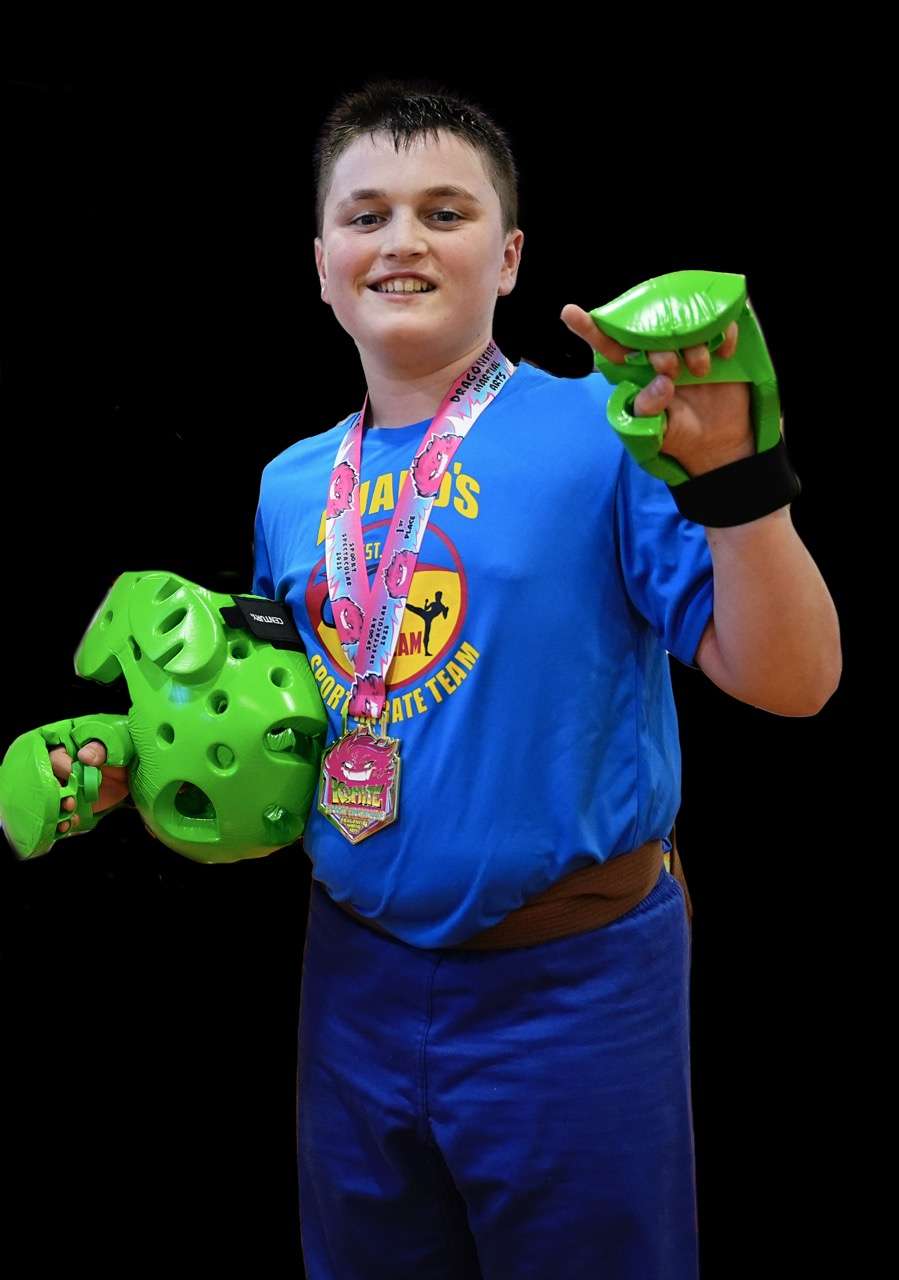
Huard’s Sport Karate Team member Jackson Hanson, 13, of Clinton, captured first place at the Spooky Spectacular last month, in Portland. (photo by Galen Neal, Central Maine Photography)
 by Mary Grow
As promised, this article will start with information on Samuel Varnum and Solomon Whidden (or Whitten), Revolutionary War veterans named in Major General Carleton Edward Fisher’s 1970 history of Clinton, Maine. Their (incomplete, as usual) stories will be followed by information on three more veterans, Elnathan Sherwin, Isaiah Brown and Benoni Burrill.
* * * * * *
Samuel Varnum (born Feb. 17, 1747 [Fisher] or 1746 [WikiTree, whose writer adds a Jr. after his name]) in Dracut, Massachusetts, did not move to Clinton until after his Revolutionary service, Fisher wrote. He enlisted for a year in the spring of 1776, and later in 1776 for three years.
A Varnum genealogy, digitized and on line, says Varnum first enlisted as a private in a company commanded by his brother, Capt. Joseph Bradley Varnum. He and many other men from Dracut transferred to the Continental Army; Varnum joined the Ninth Continental Infantry, in a regiment the genealogist wrote was mostly Rhode Islanders and was “formerly commanded by his brother, afterwards Brigadier-General James Mitchell Varnum.”
Fisher and the genealogist listed three New York battles in which Varnum’s unit was involved: Long Island (Aug. 27, 1776), King’s Bridge (aka Kip’s Bay, Sept. 15, 1776) and Harlem Heights (Sept. 16, 1776). WikiTree references his presence in Rhode Island in May and October, 1778.
Wikipedia calls the Battle of Long Island (aka Battle of Brooklyn, Battle of Brooklyn Heights) the first major battle after the Declaration of Independence and “the largest battle of the Revolutionary War in terms of both troop deployment and combat.” The British won and thereby “gained access to the strategically important Port of New York, which they held for the rest of the war.”
Less than a month later, the British extended their territory with an amphibious attack at Kip’s Bay. Wikipedia describes 500 Connecticut militia, armed with “homemade pikes constructed of scythe blades attached to poles” instead of muskets, facing an hour’s cannonading from five British warships, followed by a British landing force of 4,000 men (and later another 9,000). Despite General George Washington’s attempts to rally them, the Americans fled.
Kip’s Bay was close to Harlem Heights, in the northwestern part of Manhattan Island. Here Washington’s forces defended their position against British troops led by Major General Henry Clinton. Wikipedia says, “The battle helped restore the confidence of the Continental Army after suffering several defeats. It was Washington’s first battlefield success of the war.”
Fisher said Varnum moved to Clinton by 1781, and might have spent most of the rest of his life there. An on-line source puts him on the Kennebec, in the area that soon became Pishon’s Ferry, in 1789 or 1790. (Pishon’s Ferry was almost opposite Hinckley, in northern Fairfield, where Route 23 now crosses the river.)
WikiTree says Varnum was in Canaan in 1790 and 1800, in Clinton in 1810 and 1820.
Fisher wrote that Varnum married Mary Parker. The genealogy says they had three daughters between Feb. 11, 1789, and July 10, 1793, and on March 4, 1795, a son, Samuel, Jr. Two of the daughters married Vassalboro men.
After 1818, Varnum received a pension. The genealogy says it was $96 annually; by the time he died in January 1828, his pension income totaled $933. 06.
This source says Mary was still living in 1820, aged 71.
* * * * * *
Solomon Whidden or Whitten, Fisher said, was born June 1, 1754. WikiTree names his birthplace as Swan Island, York County (probably the Swan Island in the Kennebec, now in Sagadahoc County).
In May, 1777, from Bath, he enlisted for three years. WikiTree lists him as a private in two Massachusetts regiments and as a Massachusetts militiaman.
Whidden’s 1835 application for a veteran’s land grant, reproduced on line, is hard to read, because of the handwriting and because he ran short of space to describe his military career and overlapped some lines. It appears to say that he was present at General John Burgoyne’s surrender (at Saratoga, New York, on Oct. 17, 1777) and was discharged at West Point, New York, after serving his full three years.
He must have come to Clinton (or thereabouts) promptly, Fisher said, because when, on Sept. 26, 1781, his marriage intentions were filed, both he and his intended, Esther Goodwin (born in Castine in 1762, WikiTree says), were listed as from Kennebec (often used to mean Kennebec County; but Kennebec County was not created until Feb. 20, 1799, so in this case probably the Kennebec Valley). WikiTree says the marriage was in Canaan.
WikiTree lists four sons and three daughters, born in Canaan between 1782 and 1799. Fisher wrote that Esther died in 1814 (April 8, 1814, WikiTree says), and Whidden later married Sarah Boyton (born about 1756), for whom your writer found no more information.
In the 1780s and 1790s, Whidden lived mostly in Canaan. Fisher found that he “built the first sawmill on what is now the Carrabassett Stream [which flows into the Kennebec at Pishon’s Ferry] sometime before 1795,” when he sold it.
When he applied for a military pension in 1820, he was in Clermont County, Ohio, Fisher said.
Fisher wrote, “In August 1826 he returned to Maine to spend the remainder of his days with his children….” In his May, 1835, land grant application, Whidden said he lived in Milburn and had been a Maine resident for more than 54 years.
Whidden died in Skowhegan on Oct. 4, 1841, aged 87.
* * * * * *
Fisher said Elnathan Sherwin was “definitely known to have served” during the Revolution, but gave no details (nor did your writer find any on line). Fisher also wrote that later, Sherwin “was a lieutenant in Clinton’s first militia company, commissioned in 1787.”
Elnathan Sherwin was born in 1737 – March 9, online sources say – in Boxford, Massachusetts. His wife was Eunice Brown, (born in Holden, Massachusetts, in 1740, or February of either 1741 or 1742), oldest daughter of Ezekiel Brown, Sr. (making Sherwin brother-in-law of Ezekiel Brown, Jr., whose life was summarized in last week’s article).
FamilySearch says the wedding was Jan. 22, 1761, in Dunstable, in northern Massachusetts. FamilySearch and Find a Grave say their first son, Elnathan, Jr., was born in 1759, in Maine or in Dunstable. Geni says Elnathan, Jr., was born in October, 1762; WikiTree says 1762, in Dunstable; Ancestry says 1763.
FamilySearch and Ancestry.com list Elnathan, Jr, as the oldest of five children, naming three daughters and a second son born between 1765 or 1766 and 1778. Birthplaces, when supplied, mention Maine (not any town) and Massachusetts.
The senior Elnathan Sherwin was approved for a lot in Clinton in December, 1772, having been clearing it since the summer.
Daughter Mary was born in 1773, Ancestry says in Concord, Massachusetts. Fisher said she married (no date) John Whidden (born on Swan Island 1771), and their three sons and one daughter (named Triphena) were born between 1799 and 1806.
WikiTree names Solomon Whidden’s youngest brother as John, born on Swan Island March 10, 1771. This source lists John and Mary Whidden’s five children, three sons (the oldest was John, Jr., born July 13, 1799) and two daughters, Triphena (born July 23, 1801) and Mary Elizabeth (born March 2, 1812).
Fisher found that when Clinton organized an infantry company in October 1787, as part of the Lincoln County militia, Sherwin was the first man to serve as lieutenant, from Oct. 25, 1787, until he “moved prior to Sept. 1791.”
The Sherwins left Clinton in 1791 and returned by 1810, Fisher said. In 1810 (probably according to the 1810 census), the family included a teen-age girl named Cleopatra, whom Fisher identified as the Sherwins’ daughter Mary’s illegitimate daughter.
By 1814, the Sherwins were in Waterville, Fisher wrote. Find a Grave says Elnathan died in March 1815, in Clinton and Eunice died Oct. 30, 1829, in Holden; both are buried in Nashua, New Hampshire.
The Waterville centennial history has many references to Elnathan Sherwin, including his service in the War of 1812 and in the Massachusetts legislature for all but two years from 1799 through 1815: this man must have been Elnathan Sherwin Jr.
* * * * * *
Another Revolutionary veteran connected with Clinton was Isaiah Brown. Your writer hopes he was not closely related to the Ezekiel Brown Jr., who was profiled last week, because Fisher said Ezekiel’s sister, Abigail, was Isaiah’s second wife.
Isaiah Brown was born June 10, 1745, in Holden, Massachusetts (per WikiTree) or June 21, 1745, in Clinton, Massachusetts (per FamilySearch). (The two towns, north of Worcester, are about 13 miles apart.) In Holden, on Nov. 8, 1770, he married Phebe Howe, born in Rutland, Massachusetts, in 1749 (WikiTree). They had one child, a daughter named Dorothy, born Sept. 2, 1773.
Phebe died July 6, 1775, and both websites say on Dec. 27, 1775, Brown married Abigail (Nabby) Brown (born in 1751 [WikiTree] or 1753 [FamilySearch and Fisher]), in her home town of Concord, Massachusetts (well east of his former home).
Brown was a minuteman in Holden; his regiment responded to the events of April 19, 1775. At some point, he became a lieutenant in the Continental Army’s 18th Massachusetts Bay Provincial Regiment.
Wikipedia says this regiment was among those in the siege of Boston, until it was disbanded “at the end of 1775.” (The British did not evacuate Boston until mid-March 1776.)
Assuming accuracy of sources, the Browns soon left Massachusetts for Clinton. Their first son, Thomas, was born there Sept. 28, 1776, WikiTree and FamilySearch say (Find a Grave says Sept. 19, 1776).
FamilySearch (but not WikiTree) says Isaiah and Abigial had eight more children, five girls (the oldest was named Phebe) and three boys, born between 1778 and 1796. The site claims two girls, Sarah (1782) and Polly (1784), were born in Clinton, the rest in Holden.
Fisher wrote that Brown opened what might have been Clinton’s first tavern around 1800 at current Benton Station, and had a store there in 1807. He served briefly as a selectman in 1803.
Brown died in November 1815, and, FamilySearch says, is buried in Ames Cemetery, in Benton (formerly part of Clinton). Abigail died in Clinton in September, 1832.
Find a Grave says 84 Browns (from at least two families) are buried in Ames Cemetery. They include Isaiah and Abigail and their youngest son, Luke (Jan. 24, 1795 – October 28, 1890), and his wife, Mary “Polly” (Gilman) Brown (Jan. 21, 1795 – Jan. 18, 1866).
* * * * * *
Benoni Burrill was born Sept. 7, 1756, in Abington, Massachusetts, son of Thomas and Grace (Garnett) Burrill. (He was probably related to the Nathaniel Burrell profiled last week; your writer hasn’t the patience to untangle the genealogy.)
WikiTree’s biography says Burrill’s first military service was for three days in April 1775, when he was a private in a company that responded on April 20 to the April 19 events at Lexington and Concord. WikiTree does not explain why the company marched east toward Marshfield instead of heading north toward the Boston area.
On May 1, 1775, Burrill enlisted and served for three months plus eight days. On May 15, 1777, when he was 21 years old, he joined the Continental Army from a North Abington company, enlisting for three years or the duration of the war and serving as a fifer and a drummer.
Discharged Aug. 9, 1780, he re-enlisted and served in 1783 and 1784 (British commander Charles Cornwallis had surrendered at Yorktown on Oct. 19, 1781) at Castle Island and Governor’s Island, in Boston Harbor. FamilySearch says he was promoted to corporal during this time.
FamilySearch says Burrill was always a musician. The site describes Fisher’s statement that he was “promoted to quarter gunner” as a mistake, due to a mistranscription of a hand-written record, which also changed his first name from Benoni to Benjamin.
Burrill and Lydia Ripley (born Feb. 26, 1761, in Weymouth, Massachusetts, about eight miles north of Abington) were married in Abington on May 26 or May 27, 1779. FamilySearch says they had six sons (including Benoni, Jr.) and five daughters between 1782 and 1803, all born in Abington.
Burrill died April 9, 1814, in either Clinton (Fisher and WkiTree) or Corinna (FamilySearch). His widow died June 12, 1852, in Corinna, where both are buried.
Fisher, Major General Carleton Edward, History of Clinton, Maine (1970)
Websites, miscellaneous.
by Mary GrowMajor General Carleton Edward Fisher’s 1970 history of Clinton includes a chapter on settlers who moved into the territory that became the town before 1782. He identified 10 of the men he named as Revolutionary veterans: Ezekiel Brown, Jr.; Nathaniel Burrell; Ezekiel Chase, Sr., and three of his six sons, Roger, Ezekiel, Jr. and Jonathan; Fred Jackins; John Spearin, Jr.; Samuel Varnum; and Solomon Whidden or Whitten.
In a later chapter on the military, Fisher named more Revolutionary soldiers, identifying seven who “were proved beyond a doubt to have lived in town during the war and then went into service from here.” They were Ezekiel Brown, Jr., the four Chases, John Spearin, Jr., and William Kendall; the latter’s service was described last week in the article on Fairfield. Still later, in an appendix, Fisher added information on another 16 Revolutionary veterans who died in Clinton.
Due to space limits, this week’s article cannot talk about all these men. Readers tired of the Revolutionary War may skip next week’s installment.
Your writer, after years of dealing with endless contradictions among and within historical sources, commends Fisher’s work highly. He obviously did a great deal of research from many sources on a wide variety of topics and produced a readable and informative book that has the additional virtue of being well indexed.
* * * * * *
Ezekiel Brown Jr., was born in Concord, Massachusetts, in 1743, or on March 8, 1745 (Fisher gave two different dates in two different chapters; Find a Grave says 1745). On Feb. 28, 1770, Brown married Mary Barron (born Jan. 20, 1752, in Concord). They probably moved to Clinton in 1772.
In May 1774, when Ezekiel and Mary’s second child (of 10) and oldest son, Ezekiel, 3rd, was born, the family was back in Concord. Fisher surmised Ezekiel, Jr., might have been studying medicine there, because on June 7, 1776, he “was commissioned a surgeon’s mate in Col. Jonathan Reed’s regiment,” and on Jan. 1, 1777, a surgeon in Col. Brook’s regiment.
Fisher wrote that Brown’s service involved participation in battles leading to British General John Burgoyne’s surrender at Saratoga, New York, on Oct. 17, 1777; and with General Sullivan’s Indian Expedition, the June through October, 1779, American attack led by Major General John Sullivan against upstate New York Iroquois tribes siding with the British.
Brown was discharged Jan. 1, 1781. Fisher wrote that the family returned to Clinton sometime between 1788 and 1790, and Brown became the town’s first doctor. He was also the first town meeting moderator, and served repeatedly; a selectman “almost continuously from 1797 to 1818”; town clerk for four years, tax collector for three years.
In 1818, Fisher wrote, Brown stated in his pension application that he was “unable to do much in his profession” because of age and the loss of “use of his left arm six years before.” The pension was granted.
Brown died in Clinton June 30, 1824; his widow died May 6, 1832. They are buried in Benton’s Ames Cemetery, as are at least four of their sons (among the 85 Browns buried there, according to Find a Grave) and one daughter, Elizabeth (Brown) Gray.
* * * * * *
Fisher listed Nathaniel Burrell (or Burrill) as one of the four sons of John Burrell, Sr., and his wife, Anne (Vinton) (or Anna Vinton, per WikiTree), who came from Massachusetts to Clinton sometime before October, 1781. John, Jr. (born in 1753), Bela (born May 20, 1756), Ziba (born in 1765) and Nathaniel (no birth date given), “who served in the Revolutionary War,” joined the parents.
Nathaniel Burrell is not listed in Fisher’s chapter on the military; nor in his appendix listing Revolutionary War veterans who died in Clinton; nor on any on-line source your writer found. Websites WikiTree and Geni name only John, Jr., Bela and Ziba as John and Anna’s sons.
Geni says John, Jr., was born Oct. 5, 1763 (a decade later than Fisher cited from the 1799 Clinton records), and was a private and a “Rev. War gunner.” Fisher wrote that John Burrell, Jr., had an inn near Pishon’s Ferry on the Kennebec (opposite Hinckley, in northern Fairfield, where state route 23 now crosses the river) in 1810; he was tax collector that year “and held other town offices.” Geni says he died Sept. 1, 1842, in East Sangerville, in Piscataquis County, Maine.
* * * * * *
Fisher identified Ezekiel Chase Sr., as “probably” Clinton’s first settler, referencing a 1771 petition for a land grant from the Kennebec Proprietors in which Chase claimed to have lived on the east side of the Kennebec for 10 years, with a “son that is 18 years old” living on an adjacent lot.
WikiTree says Chase was born May 24, 1728 (FamilySearch says May 28), in Newbury, Massachusetts. He married Anna Spaulding, born in 1731, in Chelmsford, Massachusetts, in Hallowell (or in Fairfield, as his second wife, WikiTree says) in 1747.
Fisher listed one daughter and six sons with birth dates between 1748 (daughter Eleanor) and 1775.
If the family was in Clinton in the 1760s, Fisher dismissed as obviously in error a genealogy that says all the Fisher children were born in Hallowell (although he said Roger [1749] and Ezekiel, Jr., [1761] were, as he named Revolutionary veterans in a later chapter). Other sources offer other birthplaces.
Ezekiel and Anna’s oldest son, Roger, was born Sept. 5, 1749, and in 1771 would have been in his early twenties. Fisher identified him as “without a doubt” the one referenced in his father’s petition. (Perhaps the father meant a son who was over 18?)
Fisher wrote that the Chases went to Hallowell when the Revolution started. Roger was still or again in Clinton in the fall of 1776, when he married a widow named Mary (Smith) Spear there; Fisher surmised he was managing the family’s property.
Ezekiel, Sr., enlisted in a light infantry company from Rowley, Massachusetts, Fisher wrote. (Newbury, his birthplace, and Rowley are north of Boston, about six miles apart.) Fisher said he was paid for service from July 18 to Dec. 31, 1780; but FamilySearch says he “registered for military service in 1781.”
FamilySearch says Ezekiel, Sr., died Jan. 1, 1808, in Fairfield.
Roger enlisted June 1, 1775, “and served …for two months and five days,” Fisher said. He was in Colonel John Nixon’s regiment. Your writer found no other record of his military service. On-line sources say he died Nov. 25, 1819, or June 25, 1822, in Concord, Maine.
Ezekiel, Jr., born June 4, 1761 (in Hallowell, per Fisher, or in Plymouth, Massachusetts, per WikiTree), enlisted from Milton, Massachusetts (about 35 miles from Plymouth; both towns are south of Boston), beginning his service May 18, 1778, apparently for nine months. On Jan. 7, 1781, he re-enlisted, Fisher said.
WikiTree says Ezekiel, Jr., served in 1777 with the Ninth Massachusetts Regiment of the Continental Army.
A descendant posted on the Maine Secretary of State website that Ezekiel Jr., was 16 when he joined the Continental Army. He served in Rhode Island, and was at the 1780 Battle of Springfield, in New Jersey. That same year, “he was captured by the British and imprisoned in the prison ship Jersey in New York harbor for 2 years.”
The account continued: “After the peace was signed, he struggled to get back to Maine, traveling in a cart because he could not walk.” In Maine, his descendant said, he was the second white settler in future Piscataquis County.
WikiTree says Ezekiel, Jr. died Sept. 14, 1843, in Sebec, a southern Piscataquis County town. The descendant gave his home town as Milo, about six miles from Sebec.
The descendant’s account adds that Roger Chase lost two brothers in the war, “one at sea, and Jonathan Chase at the siege of Yorktown in 1781.”
Fisher listed Ezekiel and Anna’s second son, who would have been born between 1750 and 1760, as “Jacob, went to sea and never heard from.” He gave no dates nor other details.
Jonathan, born in 1767 (one on-line source says July, 1767), was drafted Feb. 2, 1778 (according to Fisher; he would have been 10 years old, if all dates are correct), and according to the descendant quoted above and other sources was killed on or about October 19, 1781, during the Battle of Yorktown. Fisher’s two reports on his death, unlike the descendant’s, are worded uncertainly: “is said to have died” and “was reported deceased.”
* * * * * *
Frederick Jackins (or Jacquins, Jackings, many other spellings) was mentioned in the Sept. 11 article in this series as carrying a letter to Québec for Colonel Benedict Arnold as Arnold’s 1775 expedition passed through Clinton on its way up the Kennebec.
WikiTree says Jackins was born in Clinton in 1750, son of Christopher Jackins, who was born somewhere in Maine in 1729 and died in Clinton Village in December 1828, and an unknown mother. This source and Ancestry identify Frederick’s wife as Elizabeth (Jeakins) Jackins (1752 – 1800); both sources claim Frederick and Elizabeth were born in Clinton (a decade or so before the first settlers arrived?).
Your writer found no reference to Jackins’ military service elsewhere in Fisher’s history, nor in any on-line source. He and Elizabeth had three daughters, according to WikiTree, born in 1770, 1775 and 1778. Fisher listed Jackins as a town tax collector in 1797; WikiTree says he died in 1820, in Clinton.
* * * * * *
John Spearin Jr., Fisher said, was born March 4, 1764, in Pownalborough, according to a 1799 town record; but his 1818 application for a pension gave his birth date as March 3, 1765.
His parents, John Spearin Sr. (born July 20, 1720, in Portsmouth, New Hampshire; died in 1790 in Clinton) and Sarah (Call) Spearin (born Sept. 8, 1740, in Amesbury, Massachusetts; died about 1790 in Portsmouth) were married in 1740 and moved to Clinton around 1770.
John, Jr. was a Clinton resident in March 1781, when he went to Beverly, Massachusetts, and enlisted. Fisher commented that John Jr., “is one of the few men who can be proved was living in town and went to that war from here.”
Spearin served in two Massachusetts and one New Hampshire regiment; was at “the capture of Cornwallis [Oct. 19, 1781] and other skirmishes”; and was discharged Dec. 31, 1783.
He came back to Clinton and on Nov. 9, 1784, married Mary Kendall, of Fairfield, sister of William Kendall (see last week’s article). Fisher noted that her birth date was listed as 1765 in the 1799 town record and 1767 in the 1818 document. WikiTree says April 15, 1764: FamilySearch says April 18, 1764.
Fisher said the Spearins had six daughters and four sons between 1786 and 1808, born in Fairfield, Clinton and other towns as the family moved around.
Fisher wrote that Spearin died Nov. 9, 1831, in Hartland. Mary’s death date is given on line as Feb. 20, 1852.
Fisher, Major General Carleton Edward, History of Clinton, Maine (1970)
Websites, miscellaneous.
by Mary GrowBefore continuing upriver, this subseries will summarize the one Revolutionary event that did have a direct impact on towns along the Kennebec River. That was the fall 1775 American expedition intended to take Québec City from the British (who had taken it from the French in September 1759).
In September and October of 1775, Colonel Benedict Arnold led an army of about 1,100 men from Newburyport, Massachusetts, up the Kennebec River, across the Height of Land and down the Chaudiere River to the St. Lawrence.
Among documents at Fairfield’s Cotton Smith House, home of the Fairfield Historical Society, is a 1946 Bangor Daily News article quoting Louise Coburn’s Skowhegan history: she said the army consisted of 10 New England infantry companies and three companies of riflemen from Pennsylvania and Virgina.
(The 1890 Cotton Smith House has been on the National Register of Historic Places since 1992.)
Scattered partial reenactments of this “march to Québec” are being organized in the fall of 2025. Among organizing groups is the Arnold Expedition Historical Society, headquartered in Pittston’s Reuben Colburn house (built in 1765, a state historic site and on the National Register of Historic Places since 2004).
A personal note: your writer learned about Arnold’s march to Québec when she was very young, through the historical novels of Maine writer Kenneth Roberts. Arundel, published in 1930, tells of the expedition and the unsuccessful attack on the city. Rabble in Arms, published in 1933, is the story of the army’s retreat down the St. Lawrence and Richelieu rivers and Lake Champlain.
Roberts highly admired General Arnold. Each novel is told from the perspective of a participant looking back to his youth, so there are references to Arnold’s subsequent switch to the British side; but his conduct in 1775 is consistently praised, and his detractors damned.
Captain Peter Merrill, of Arundel, Maine, fictional narrator of Rabble in Arms, explained that he intended to write a history of part of the war, and found Arnold “an inseparable part” of his project. He wrote:
“Benedict Arnold was a great leader: a great general: a great mariner: the most brilliant soldier of the Revolution. He was the bravest man I have ever known. Patriotism burned in him like an unquenchable flame.”
Why, then, did Arnold switch sides in September 1780? To Roberts (and a few others) the answer is, again, patriotism. Having witnessed the incompetence, corruption and general worthlessness of the Congress that mismanaged the war, costing – wasting – too many lives, Arnold believed the country’s salvation required re-submitting to British rule, with competent Americans as administrators, until the colonies were strong enough to revolt successfully.
* * * * * *

Benedict Arnold
Arnold’s army left Massachusetts on Sept. 19, 1775; reached the mouth of the Kennebec the next day; and stopped first at Gardinerstown (later Pittston), south of Augusta. Here 200 wooden bateaux had been hastily built in Reuben Colburn’s shipyard at Agry Point (named for a 1774 settler), on the east bank of the Kennebec.
(An on-line map shows the Colburn House on Arnold Road, and Agry Point Road running south from the south end of Arnold Road and dead-ending on the south side of Morton Brook.)
According to Colburn House information on the Town of Pittston’s website, Colburn had suggested attacking Québec via the Kennebec and had sent General George Washington “critical information.” Given only about three weeks’ notice to provide the bateaux, he had had to use green lumber, which did not hold up well; the boats leaked copiously, and fell apart under rough handling, on the water and on portages.
The website says Colburn himself and some of his crew went upriver with the troops, “carrying supplies and repairing the boats as they traveled.”
Henry Kingsbury, in his 1892 Kennebec County history, wrote that the army moved immediately upriver to Fort Western in future Augusta, where Arnold arrived on Sept. 21. For more than a week, he and some of his officers stayed with Captain James Howard at the fort.
On the evening of Sept. 23, Kingsbury wrote (using Capt. Simeon Thayer’s diary of the expedition for his source), a soldier named John McCormick got into a fight with a messmate at the fort, Reuben Bishop, and shot him. A report in the January-February, 2022, issue of the Kennebec Historical Society’s newsletter says alcohol was involved.
A prompt court-martial ordered McCormick hanged at 3 p.m. Sept. 26. Arnold, however, intervened and forwarded the case to Washington, “with a recommendation for mercy.” The KHS report says McCormick “was sent to a military jail in Boston, where he ultimately died of natural causes.”
On a website called Journey with Murphy reached through Old Fort Western’s website, a descendant of Sergeant Bishop called him “the first casualty of the Arnold expedition.” She wrote that he was born Nov. 2, 1740 (probably in central Massachusetts); enlisted soon after the Battle of Lexington; and served at the siege of Boston before joining Arnold’s expedition.
By her account, McCormick’s quarrel was not with Bishop, but with his (McCormick’s) captain, William Goodrich. After McCormick was thrown out of the house where they were billeted, he shot back into it, hitting Bishop as he lay by the fireside.
Bishop was buried somewhere near the fort. Kingsbury believed Willow Street was later “laid out over his unheeded grave.” His descendant wrote that his body was moved to Fort Western’s cemetery, and was by 2024 in Riverside Cemetery.
On Sept. 24, 1775, James North wrote in his 1870 Augusta history, Arnold sent a small exploring party ahead to collect information about the proposed route. They went most of the way across the Height of Land. North said the party’s guides were Nehemiah Getchell and John Horn, of Vassalboro.
Alma Pierce Robbins mentions in her 1971 Vassalboro history several earlier histories. One, she said, referred to “Berry and Getchell who had been sent forward…,” implying that they were part of, or guides for, the scouting party.
Different sources list other local men as guides for parts of the expedition. WikiTree cites a 1979 letter from a descendant of Dennis Getchell, of Vassalboro (see last week’s article) saying Dennis and three of his brothers, John, Nehemiah and Samuel, were scouts for Arnold, with Arnold’s journals as the source of the information.
Rev. Edwin Carey Whittemore, in his 1902 centennial history of Waterville, also named Nehemiah Getchell and John Horn as guides for the exploring party. He added, quoting an unnamed source, that a man named Jackins, who lived north of Teconnet Falls, served as a guide for the expedition.
Major General Carleton Edward Fisher, in his 1970 history of Clinton, wrote that Jackins (Jaquin, Jakens, Jackens, Jakins, Jackquith) was a French (and French-speaking) Huguenot who came to Winslow via Germany around 1772. Fisher believed Arnold sent Jackins to Québec with a letter in November 1775, citing expedition records kept by Arnold and others.
(Your writer, extrapolating from other sources, guesses the letter was to supporters in and around Québec letting them know an expedition was on the way.)
Two Native guides, Natanis and Sabatis (Sabbatis, Sabbatus), are named in several accounts, and in Kenneth Roberts’ novel. Some sources identify them as Abenakis (also called Wabanakis), others specify the Abenaki/Wabanaki band called Norridgewocks. Some say the two men were brothers or cousins.
Robbins called them “guides of no mean ability.” Both spent time in Vassalboro, she wrote, and “there are a few reports of those settlers who actually knew these two Indians.” As of 1971, she said, Sabatis’ name was on a boulder on Oak Grove Seminary grounds. Natanis Golf Course, on Webber Pond Road, was named after the 18th-century Natanis.
North wrote that over the period between Sept. 25 and Sept. 30, Arnold’s men moved from Fort Western to Fort Halifax, some in the bateaux (with most of the supplies) and some marching along the east bank of the river on the rough road laid out in 1754, when the forts were built to deter attacks by Natives backed by the French.
Robbins cited an account that the whole army camped on both sides of the Kennebec, in Vassalboro “while their bateaux were being repaired”; and Arnold “was entertained” at Moses Taber’s house.
(Your writer found no readily available information on Moses Taber. He was probably one of the Tabers who were among Vassalboro’s early settlers. They were Quakers; Taber Hill, the elevation north of Webber Pond about half-way between the Kennebec River and China Lake, is named after them.)
In Winslow, according to Whittemore’s history, an early settler, surveyor, doctor and selectman named John McKechnie treated sick soldiers from Arnold’s army
Above Fort Halifax, there was a miles-long stretch of waterfalls and rapids. Here the men had either to unload the bateaux, carry them past the danger zone, bring up the supplies and reload the boats; or haul the loaded boats upriver, in waist-deep autumn-cold water, against a strong current, over a rocky bottom.
North quoted a letter Arnold sent to George Washington in mid-October in which he compared his men to “amphibious animals, as they were a great part of the time under water.”
Several sources say that while his army labored up-river, Arnold made his headquarters in the first house built in Fairfield, Jonathan Emery’s, a short distance north of the present downtown. The Fairfield bicentennial history says Arnold was there a week; a WikiTree biography says two weeks, during which Emery, a carpenter, helped repair some of the bateaux.
(There will be more about Jonathan Emery and his family in next week’s article.)
By the time the army reached Norridgewock Falls in early October, North wrote (referring to Dr. Isaac Senter’s journal), many of the boats were wrecked. Worse, the wooden casks of bread, fish and peas were soaked and the food ruined, leaving the men with little to eat for the rest of the journey but salt pork, flour and whatever game they could kill.
From Norridgewock, North wrote, it was forty miles to the Great Carrying Place where the army left the Kennebec to go overland to the Dead River. After a very difficult journey (described in more or less detail in numerous sources, including North), during which men died and several companies abandoned the expedition and went home, about 600 remaining soldiers reached the St. Lawrence River on Nov. 9.
They besieged Québec and, with reinforcements, attacked the city the night of Dec. 31 1775. They failed to overcome the defenders, and many men were killed, wounded (including Arnold) or captured.
* * * * * *
Kingsbury summarized one effect of the expedition on the Kennebec Valley in the first of his two chapters on military history. He wrote that “The rare beauty of the valley through which they passed, the waving meadows, the heavy forest growth, made a lasting impression” that was not erased by the much harder journey that followed. The post-war peace brought continued hardship and hunger in the valley as “famishing regiments of soldiers” seized any available food on their way to homes along the coast. It “brought, also, many of the members of the Arnold expedition back as permanent settlers.”
Kingsbury, Henry D., ed., Illustrated History of Kennebec County Maine 1625-1892 (1892)
North, James W., The History of Augusta (1870)
Local historical society collections
Websites, miscellaneous.

William Vassal
A 1770s map of Kennebec River towns upriver from Augusta would look quite different from a 2025 map, or even an 1870s map. Currently, Augusta is the only area town with territory on both banks of the river (linked by two bridges).
Upriver on the west bank, one goes from Augusta north into Sidney, then Waterville and then Fairfield. On the east bank, the next town north of Augusta is Vassalboro, then Winslow, then Benton.
In the 1770s, Vassalboro included Sidney (the two separated effective Jan. 30, 1792) and Winslow included Waterville (which became a separate town on June 23, 1802). Fairfield, then a plantation (it became a town on June 18, 1788) was on the west bank only, as it is now. Opposite it was a piece of what became Clinton when the town was incorporated in 1795; Benton became a separate town in 1842.
These future towns along the river all had small populations in 1775. As previous articles have discussed, Fort Halifax, in Winslow, was built in 1754, and the area was inhabited thereafter. Much of the rest of the river valley attracted at least scattered settlers, especially after the Kennebec Proprietors had a survey finished and lots laid out by 1761.
Hallowell (including Augusta), Vassalboro (including Sidney) and Winslow (including Waterville) had large enough populations to justify their incorporation as towns on April 26, 1771.
The 1988 Fairfield bicentennial history says the first recorded log cabin was built on the river, a couple miles north of the present downtown, in 1771; in 1774, the area had enough families to be organized as Fairfield Plantation.
In Clinton, according to Carleton Edward Fisher’s 1970 town history (quoted in the town’s comprehensive plan on line), the first settler arrived after 1761, but before the Kennebec Purchase Company (aka Kennebec Proprietors etc.) began offering lots in 1763. Other sources propose other dates.
* * * * * *
Henry Kingsbury commented in his chapter on Vassalboro in his 1892 Kennebec County history that “The records of the town from 1771 to the present are in four leather-bound books, well preserved and beautifully written.”
Alma Pierce Robbins’ 1971 Vassalboro history includes numerous excerpts from these records, with miscellaneous references to the Revolution. She described residents as “somewhat lukewarm” and said they “did their share in a dilatory manner”; but “There were many who did join their fellow countrymen in the cause for ‘Liberty.'”
The earliest vote she cited was from an otherwise undated 1773 town meeting (probably in the spring): “to be exempt from sending a representative to the [Massachusetts] General Court, and to join Boston concerning the Liberty of the Colony.”
Another meeting was called in September 1773 to hear information from Boston and see if voters would create a Committee of Correspondence. (Committees of Correspondence were the local revolutionary organizations that shared information and coordinated efforts throughout the colonies.) Whether Vassalboro had one, Robbins did not say.
Town voters did choose a “Captain of the Town for the Emergency of the times” at a Jan. 16, 1775, meeting. The first captain was Dennis Getchell (see box), assisted by two lieutenants and an ensign.
At that same meeting, Robbins wrote, voters approved a long resolve to be sent to Massachusetts authorities. It referred to the Continental and Provincial Congresses’ “almost unexplained Love for the Liberties of their Country” and agreed to abide by current and future Congressional recommendations.
Town Clerk Samuel Devens added a promise to “tender their [the town’s] assistance whenever required.” A prominent resident named Remington Hobby carried the message to Massachusetts. (Hobby was mentioned in the Aug. 21 article in this series as Vassalboro’s delegate to a 1774 provincial congress.)
Robbins wrote that by July 1776, Vassalboro’s town meetings were called “in the name of the Governor and People of the Colony of Massachusetts Bay,” replacing the British monarch. (Hallowell made a similar change in January 1775, as reported in the Aug. 21 history article.)
During the war years, Tories were as unpopular in Vassalboro as elsewhere. Robbins mentioned instances of their being mobbed or arrested.
Her chapter on wars includes no details on Vassalboro soldiers in the Revolutionary army. In an earlier article in this series (see the Feb. 3, 2022, issue of The Town Line), your writer mentioned Amos Childs, Dennis Getchell and Charles B. Webber. On-line resources list land grant applications for John Bailey, Joab Bragg and Benjamin Collins, or their widows.
* * * * * *
The first Europeans in what is now Winslow were British traders. Kingsbury cited a 1719 survey that included reference to a man named Lawson who had a trading house at the Native village of Ticonic in September 1653.
By 1675, the firm of Clark & Lake owned this business, and Richard Hammond had a second trading post at Ticonic, Kingsbury said. Neither man survived the series of wars that began that year, as French-supported Natives tried to repel settlers coming into their territory from the coast.
As part of the settlers’ advance, the Plymouth Company (aka the Kennebec Proprietors and other titles) and the Massachusetts government built Fort Halifax (and its southern neighbor, Fort Western, in Augusta) in 1754. By April 26, 1771, the town by and across the Kennebec from the fort (still intact, though demilitarized after the French and Indian Wars ended in 1763) had enough people to be incorporated as the Town of Winslow.
Kingsbury had only one comment on the Revolution in his chapter on the town. He wrote: “In 1776 the people manifested their patriotism by appointing Timothy Heald, John Tozer and Zimri Haywood a committee of correspondence.”
Rev. Edwin Carey Whittemore, in his 1902 Waterville history, listed these three men as the first Committee of Safety (later, the Committee of Correspondence, Inspection and Safety), and eight more — Ezekiel Pattee, Robert Crosby, Manuel Smith, Ephraim Osborne, Nathaniel Low, Hezekiah Stratton, William Richardson and Benjamin Runnals – as members of Winslow’s Committees of Correspondence through the war.
(Heald, Tozer and Haywood also served the town as selectman, town clerk and/or town treasurer. Ezekiel Pattee served 19 years as a selectman, three one-year stints as town clerk and, Kingsbury said, as town treasurer from 1771 to 1794, except for 1781, when Haywood had the job. In the 1780s, Haywood and Pattee each represented Winslow in the Massachusetts legislature, Whittemore said.)
In Winslow, Whittemore said, the first town meeting to be called in the name of Massachusetts Bay was on July 8, 1776.
Winslow had no money to meet the requirement to buy ammunition, so Whittemore wrote that voters borrowed shingles and clapboards from residents, including Pattee, Tozer and Heald, sold them and bought ammunition with the proceeds.
He gave no date for that transaction, nor for the decision to send three men “up the river to see whether any British force was approaching.”
As in other towns, Whittemore wrote that Winslow had trouble finding men to serve in the army and meeting government requisitions of clothing and beef.
General Isaac Sparrow Bangs did a great deal of research for his chapter on the military in the Waterville history, apologizing for the scant results and regretting that records were not compiled while Revolutionary veterans and their families were still alive. He came up with a list of more than two dozen service men’s names (a few might be duplicates), with varying amounts of information about each.
The first man on the list is Captain Dean Bangs (May 31, 1756 – Dec. 6, 1845), the writer’s grandfather. Still living on Cape Cod when the war started, he was a privateer for a year before serving in the army for two years. Dean Bangs moved to Sidney in 1802 and died there; his grandson called Waterville “his mercantile home,” from where he raised an artillery company during the War of 1812.
A private named John Cool (died Oct. 5, 1845, aged 89 years and six months) served from March 12, 1777 to March 12, 1780. Bangs wrote that on May 26, 1835, Cool wrote (on a pension or similar application?) that he was 78 years old and had been a Winslow/Waterville resident for 70 years. After his death, Bangs said, Cool Street, along the west bank of the Messalonskee Stream, was named after him.
Sampson Freeman served as a private from Feb. 1, 1777, to Feb. 5, 1780, including wintering at Valley Forge from December 1777, to June 1778. He was a free Black man who enlisted from Salem, Massachusetts; moved from Peru, Maine, to Waterville in 1835; and died in Waterville in 1843.
(The Town Line’s May 5, 2022, history article has more information about Sampson Freeman.)
Salathiel Penny or Penney (1756 – Sept. 22, 1847) Bangs found listed several times. Enlisting from Wells on May 3, 1775, Penney served eight months; he re-enlisted Jan. 10, 1776, for another 10 months; and yet again Jan. 1, 1777. Bangs wrote that Penney was “present at the surrender of [British General John] Burgoyne” on Oct. 17, 1777, at Saratoga, New York.
In another chapter in Whittemore’s history, Aaron Appleton Plaisted names Penney among pre-1800 Waterville residents.
Dennis Getchell
On-line sources say Dennis Getchell was born in Berwick in 1723 and married Mary Holmes (no dates given) in Wiscasset, in September 1761; the couple had at least 11 children, FamilySearch says. It then confuses the issue by saying all but two were born in Berwick, including those born after the Getchells moved to Vassalboro.
This source says Dennis, Jr., was born in 1771, in Clinton; or, a different source says, in Vassalboro. Daughters Anstrus and Lydia were reportedly both born in 1775, Anstrus in Berwick and Lydia in Vassalboro.
WikiTree mentions Getchell’s experience in the British military before he bought land in Vassalboro’s Riverside area in 1769 and 1770. At Vassalboro’s first town meeting, on April 26, 1771, he was elected first selectman.
WikiTree says: “On July 23, 1776, he was commissioned captain of the 5th company, 2nd Lincoln County regiment of Massachusetts militia. He and his company of 50 men served at Riverton, R. I., in 1777.”
Kingsbury agreed that Getchell was elected a Vassalboro selectman in 1771, and added that he served for eight years. In 1775, he was town meeting moderator. Another source says in 1786, he represented the town in the Massachusetts legislature.
Getchell died Aug. 23, 1791, according to a reader’s comment on WikiTree citing Martha Ballard’s diary; or early in 1792 (per WikiTree, which says his Aug. 2, 1790, will was probated Jan. 6, 1792).
Kingsbury, Henry D., ed., Illustrated History of Kennebec County Maine 1625-1892 (1892)
Robbins, Alma Pierce, History of Vassalborough Maine 1771 1971 n.d. (1971)
Whittemore, Rev. Edwin Carey, (1902)
Websites, miscellaneous.

photo credit: Hamilton College
Hamilton College’s annual Class & Charter Day took place on May 13, in Clinton, New York. Established in 1950, the event combines the traditional Class Day celebrating the end of classes with a commemoration of the granting of the College’s charter on May 26, 1812.
The following local residents were among the award winners:
Charles Haberstock, of Waterville, was named the recipient of The Senior Prize in Economics. Haberstock, a senior majoring in economics and geosciences, is a graduate of Waterville High School.
Maia Macek, of Madison, was named the recipient of The William Gillespie Prize in Art. Macek, a senior majoring in art and Hispanic studies, is a graduate of The American School in Japan.

Photo by Galen Neal, Central Maine Photography
Huard’s Martial Arts hosted the 43rd Battle of Maine Martial Arts Championships at Champions Fitness Club, in Waterville, on Saturday, March 22. Just over 350 competitors and close to 1,000 spectators attended this special martial arts event from all around Maine and New England. Special guest performers came from various parts of the United States to give demonstrations to kickoff the tournament. $1 of each admission went to help support the Maine Children’s Cancer Program.

Everly Hanson, 7, of Clinton, walking off the competition area after placing first in point fighting at the Battle of Maine, on March 22. (photo by Dawn Jaques, Central Maine Photography)

Huard’s Sport Karate Team member Kate Shores, 13, of Benton, with her medals from the 43rd Battle of Maine. She captured first place in all three divisions. (photo by Central Maine Photography)