Volunteers sought for alewife festival

Organizers of the Benton Alewife Festival are looking for volunteers to help on Saturday, May 16, 10a.m. – 3 p.m. Those who register before April 20 will get a free T-shirt.

If interested, send an email with your contact information to bentonalewifefestival@gmail.com.

They are looking for volunteers to set up tables, give directions, put up signs, helping in the food area, walking trail tours to and from the dam, smoked fish samples, T-shirt and other sales items, park cleanup and recycling, organizing children’s games, arts and crafts, printmaking activity, fish decorations, fish parade costume making. If you are crafty and creative, they could use your help.

Area scout leaders recognized with 2026 district awards

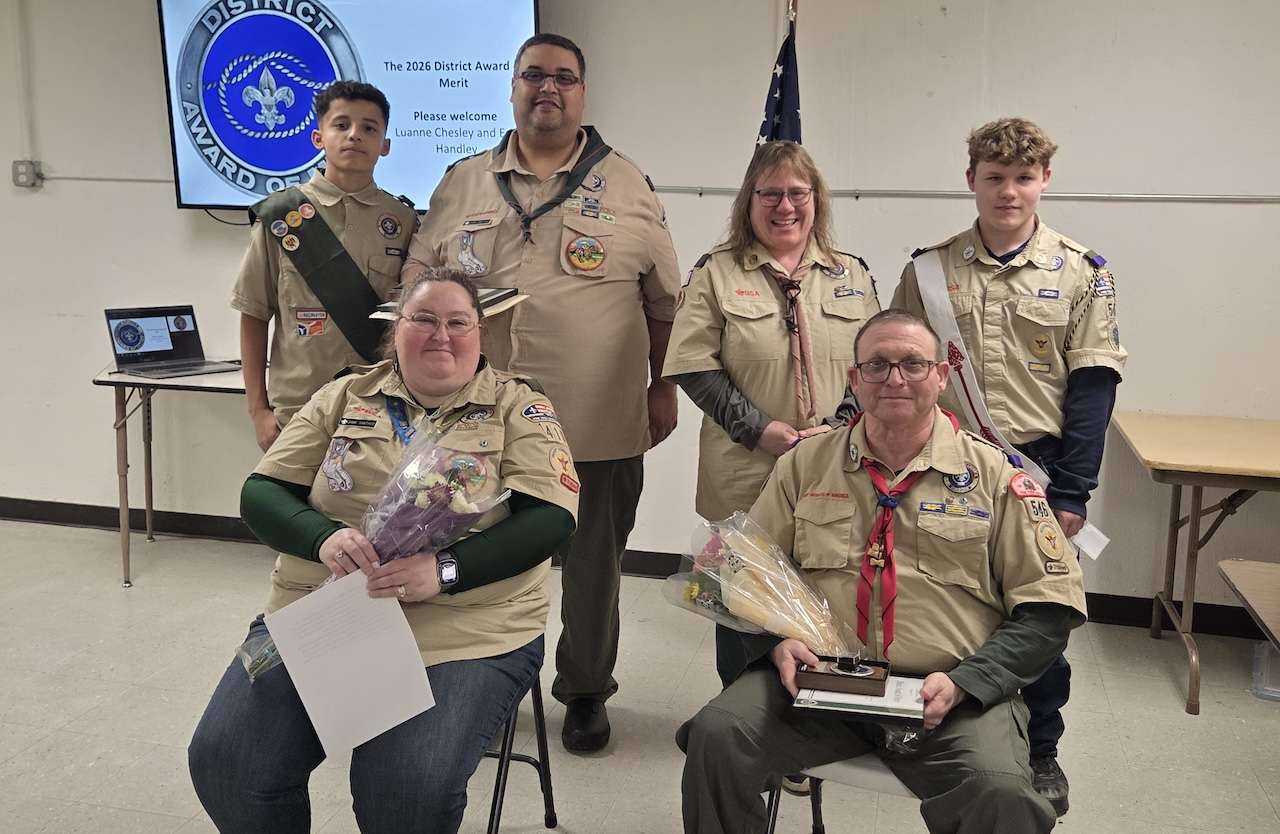
2026 District Award recipients and family. Left seated Jamie Santiago. Behind is Chritopher Santiago (son) and Christopher Santiago (husband) all from Troop #410, Vassalboro. Right seated Walter Fails. Behind is Ginger Fails (Wife) and Camaeron Fails (Son), all from Troop #546, Farmington. (contributed photo)

by Christopher Bernier

On March 14, 25 adult leaders and their families attended the 2026 Kennebec Valley District Scouting America District Awards Banquet. This year the banquet was hosted at Winslow Parks and Recreation, on Benton Avenue, in Winslow, home to Troop #433 Winslow. The banquet was catered by Rita’s Catering for the fourth year in a row. The Maine Mobile Scouting Museum was on display during the event, showcasing patches, uniforms, and other memorabilia going back as far as the beginning of Scouting in 1911.

The evening opened with the Pledge of Allegiance and short messages of encouragement and gratitude from the district’s “Key 3.” The Key 3 consists of District Chairman Eric Handley, District Commissioner Peter Lidiak, and District Executive Leah Berry. These three individuals represent the top leadership of the Kennebec Valley District of Scouting, with K-Valley being the largest district in Pine Tree Council. Following the Key 3 remarks, Christopher Santiago, of Troop #410 Vassalboro, gave the evening’s prayer before the meal.

Following dinner was the main presentation of district thank-you certificates and awards. Thank-you certificates and awards were handed out by the district chairman, the former District Commissioner, the program chairman the advancement chairman, and the roundtable commissioner.

Next were the district training awards. These awards are earned by adult leaders in Scouting America who complete additional training for their positions and successfully finish a number of required tasks. The following adult leaders were recognized:

Scouter’s Training Award – Cub Scout Level: Ginger Fails and Walter Fails, of Troop #546, Farmington.

Scouter’s Training Award – Scouts BSA Level: Marcy Gage and Don Gage, of Troop #485, Skowhegan.

Scouter’s Training Award – District Committee Level: Christopher Santiago, of Troop #410, Vassalboro.

Cubmaster’s Key Award: Walter Fails, of Troop #546, Farmington.

Scoutmaster’s Key Award: Don Gage, of Troop #485, Skowhegan,

District Key Award: Christopher Santiago, of Troop #410, Vassalboro, and Eric Handley, of Troop #401, Sidney.

Commissioner’s Arrowhead Award and Commissioner’s Key Award: Christopher Santiago, of Troop #410, Vassalboro, Julie McKenney, of Pack #454, Oakland, Eric Handley, of Troop #401, Sidney, and Chris Bernier, of Troop #433-F, Winslow.

Next were the specialty awards. The following honors were presented:

The Phil Mason Honor Scout Award.

This award is given to a Scout through nomination by his or her peers for outstanding performance and for best exemplifying the Scout Oath and Law. This year there were two recipients: Thomas Gage and Joshua Gilpin, of Troop #485, of Skowhegan.

The Raymond “Papa Bear” Award.

This award is given to adult leaders through nominations from their peers and their youth Senior Patrol Leader through letters of recommendation. This year there were two recipients: Don Gage, of Troop #485, Skowhegan, and Julie McKenney, of Pack #454, Oakland.

The Unit Leader Award of Merit.

This award is also presented through nomination by one’s peers and the unit committee chairperson. This year’s recipients were Don Gage, of Troop #485, Skowhegan, Christopher Santiago, of Troop #410, Vassalboro, and Ginger Fails, of Troop #546, Farmington.

The peak of the evening was the awarding of the District Award of Merit. The District Award of Merit is the highest distinction and recognition that can be given to any adult leader within the district. The nomination process is completed through an application with at least two letters of recommendation from one’s peers. The nomination committee reviews the submissions and may select only two recipients for the award year. This year the committee selected two dedicated individuals whose records show they consistently go above and beyond the call of duty as volunteers in Scouting America.

The first recipient of the 2026 District Award of Merit was Jamie Santiago, of Troop #410, Vassalboro. Jamie joined Scouting in 2019 when her son joined Pack #61, in Norton, Massachusetts, which is part of Narragansett Council. In 2020, Jamie and her husband Christopher moved to Vassalboro. They joined Pack #410, Vassalboro, along with their son. Jamie has held multiple positions of responsibility in her pack, and when her son crossed over into Troop #410 she also volunteered in various leadership roles to help keep the unit running smoothly.

Jamie also volunteered at various events hosted by the Kennebec Valley District of Scouting. As a result of her volunteerism, she eventually became the Kennebec Valley District Vice Chairman for Finance and also serves as a district member-at-large. Jamie later joined the District Advancement Team, where she participates in Eagle Scout candidate boards of review, which are the final step in earning the Eagle Scout Award.

Outside of Scouting, Jamie is very involved with her son’s sports teams and is a huge fan of everything Disney. She serves her community whenever she can and is truly an outstanding individual.

The second recipient of the 2026 District Award of Merit was Walter Fails, of Troop #546, Farmington. Walter joined Scouting with his son in 2017. He quickly became involved, serving as the Tiger Den Leader for their pack. He later became Cubmaster for the Farmington pack and volunteered at many of the events the pack hosted.

Eventually his son crossed over into the troop, and Walter continued his Scouting journey alongside him. During this time Walter also began volunteering at district events such as camporees and Klondike derbies. He later became involved with the District Training Committee, which is responsible for hosting training events for new volunteers and leaders to prepare them for running a Cub Scout pack or Scout troop. From meetings to camping and everything in between, Walter and his team of trainers have helped prepare dozens of new parents and volunteers to provide quality Scouting to youth across the Kennebec Valley District.

Outside of Scouting, Walter loves the outdoors. He enjoys hunting, fishing, camping, hiking, Dutch oven cooking, canoeing, and leatherworking. He also volunteers when he can with the American Legion in Farmington. Walter is also a third-degree Master Mason in the fraternal society of Freemasonry.

These two volunteer Scout leaders are truly valued within the Scouting community. Without their dedication and love for Scouting, the Kennebec Valley would be a very different place. The award was presented to both individuals with their families and their Scouting families present. Each received a plaque engraved with their name, a special patch for their uniform, a certificate, a pin, and a bouquet of flowers.

If you are interested in Scouting America or wish to volunteer, please contact your local Scouting unit or Pine Tree Council, Scouting America. You can also visit beascout.scouting.org.

Two area martial arts students capture state titles

Huard’s Martial Arts student Kate Shores, 14, of Benton, recently captured both the divisional and state championship titles for forms, weapons and fighting. (photo by Central Maine Photography)

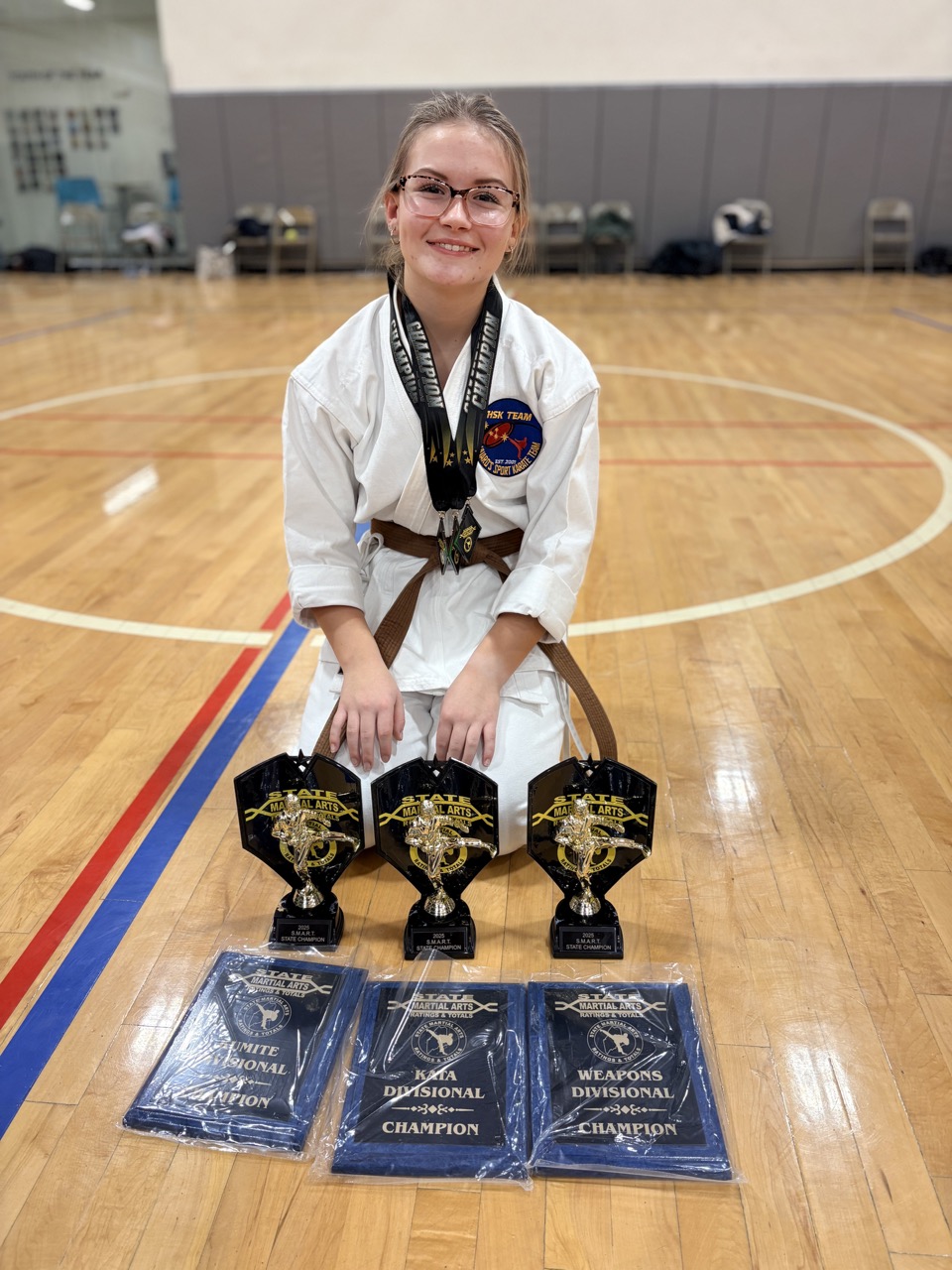
Huard’s Martial Arts student Isabella Citro, 17, of Waterville, captured the State Karate Championship Title for 2025. (photo by Central Maine Photography)

Zachary LeHay earns Eagle Scout status

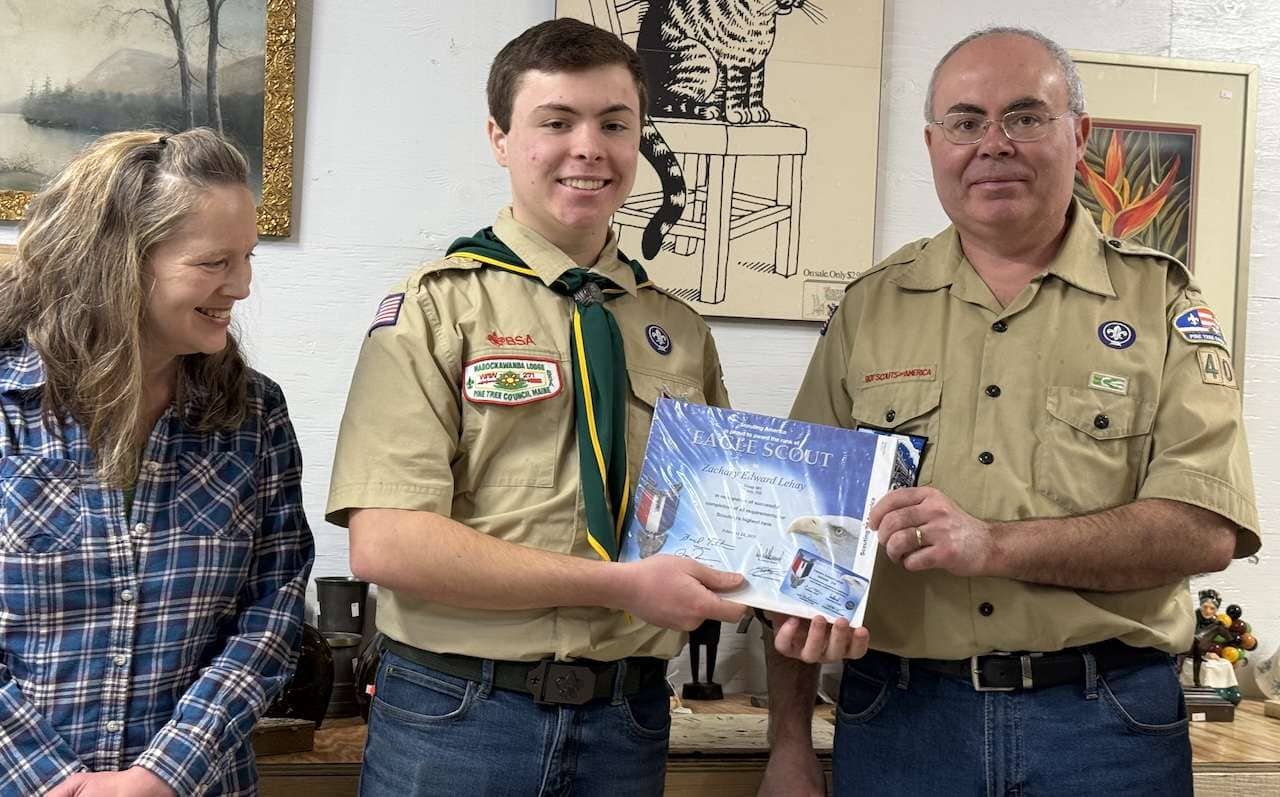
Charity LeHay, left, looks on as her husband Willie presents the Eagle Scout certificate to Zachary. (photo by Chuck Mahaleris)

by Chuck Mahaleris

Zachary LeHay, of Benton, son of Willie and Charity LeHay, was presented with his Eagle Scout rank and medal during a ceremony that took place at the LeHay Auction House, in Benton, on Saturday, January 3, 2026. Zachary is a member of Troop #401, in Sidney.

Troop #401 Committee Chairman Andy Steinberger said, “Today is a celebration of a journey, a journey full of challenges, friendship, struggles, and, occasionally, a little fun. Today, we think of all the Merit Badges earned along the way, the oaths committed to, the character this young man developed, and the service to our community he worked so hard to bring about. Little by little, month by month and year by year, he was faithful, and we celebrate his faith, commitment, and hard work.”

Zachary’s Eagle Scout project consisted of building and setting up U.S. Flag collection boxes in Belgrade, Oakland and Sidney, so people can drop off their frayed, tattered and otherwise unusable US flags for proper disposal.

Scoutmaster Eric Handley said, “The Eagle extends a helping hand to those who still toil up Scouting’s trail, just as others helped him in his climb to Eagle Scout. The performance of the daily Good Turn takes on new meaning, when he enters an adult life of continuing service to others. The Eagle stands as the protector of the weak and helpless. He aids and comforts the unfortunate and the oppressed. He upholds the rights of others while defending his own. He is always prepared to put forth his best.”

Matthew Christen making waves in the martial arts world

Matthew Christen

by Mark Huard

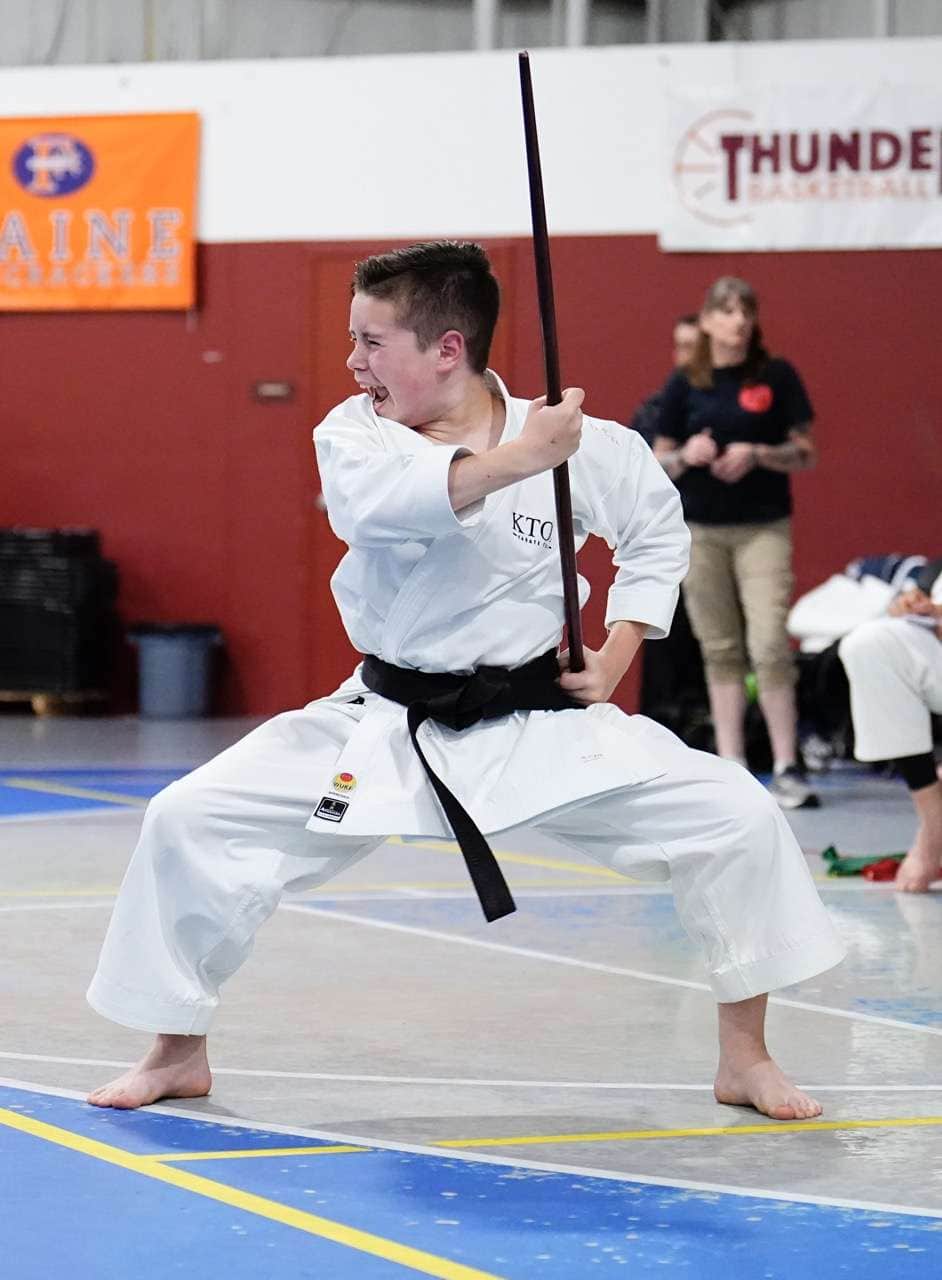
A 14-year-old from Benton is making waves in the martial arts world. Matthew Christen, a dedicated student at Club Naha Karate-Do, in Waterville, has earned a spot on the World Karate Confederation (WKC) Team USA and will represent the United States at the world tournament, held in Niagara Fall,s in October.

Matthew’s dedication to the sport is evident through his impressive performances in national competitions. He had consistently excelled in the Independent Promoters and Practitioners of New England (IPPONE), the North American Sport Karate Association (NASKA), and the Amateur Athletic Union (AAU) circuits, showcasing his skills and commitment to martial arts.

Most recently, Matthew competed in Fort Lauderdale, Florida, at the AAU National Championships. He brought home a gold medal and was crowned champion in the 14-year-old black belt division.

Matthew’s inclusion in WKC Team USA is not just a personal achievement but also a testament to the support he receives from his national team, KTOC, in New York City. Despite his rising success on the national stage, Matthew remains deeply connected to his roots at Club Naha. His instructor, Craig Sargent, has been instrumental in shaping his martial arts journey, emphasizing the development of character, discipline, and respect – values that Matthew holds dear.

Matthew Christen in action. (contributed photo)

PHOTO: Knowledge Fair project

Benton Elementary School fourth grader, Jackson Reynolds, loves law enforcement. For his knowledge fair project on social studies, his subject matter was, naturally, law enforcement, and he chose to center his project around Corporal Eugene Cole. Jackson even dressed in his own Deputy uniform for his project presentation. Jackson did an excellent job, and I want to thank him for focusing his project on Corporal Cole, said Sheriff Dale Lancaster. (contributed photo)

EVENTS: Benton Alewife Festival to be celebrated on May 17, 2025

The annual Benton Alewife Festival will be back again this year on Saturday, May 17, 11 a.m. – 3 p.m., at the Riverfront Park, to celebrate the return of the alewives to the Sebasticook river. The alewife, also known as river herring, is one of many anadromous (migrating) fish that make their way over ninety miles from the ocean to find its habitat in the Sebasticook lake.

The first year of the festival was in 2012, but its origins were sparked by the removal of the dam in Winslow in 2008, and the first alewife harvest was in 2009. Along with the installation of a fish elevator at the Benton dam, the alewives were able to thrive and complete their life cycle by making it to Sebasticook lake. And thrive they did!

Thanks to these fish passage efforts, the alewife runs are steadily growing, with a record breaking 6.5 million fish counted at the Benton Falls dam in 2024. Along with the return of the fish, the eagles, ospreys and other wildlife that rely on these fish have also returned. It is not uncommon for people to report seeing “dozens of eagles” along the river below the Benton dam.

When the first harvests began, the town decided to have a festival to celebrate this landmark achievement. Now in its 13th year, the festival is held at the Benton Riverfront park, next to the town office. The festival will feature a number of free, family friendly activities including demonstrations, guided trail walks, tours of the dam, children’s activities, arts & craft projects, face painting and games, as well as food and live music. The highlight of the event is the tours of the dam, which can be reached by walking trail or free shuttle from the parking lot at the Benton Town Office.

Exhibitors include: Maine Rivers, L.C. Bates Museum, Arnold Expedition Historical Society, Kennebec-Messalonskee Trails, Sebasticook Regional Land Trust, Benton Historical Society, St. Joseph Nature Sanctuary, a local beekeeper, a wood carver, and Forest Rangers from the Maine Forest Service. This event will take place rain or shine!

Huard’s Martial Arts hosts the 43rd Battle of Maine

Photo by Galen Neal, Central Maine Photography

Huard’s Martial Arts hosted the 43rd Battle of Maine Martial Arts Championships at Champions Fitness Club, in Waterville, on Saturday, March 22. Just over 350 competitors and close to 1,000 spectators attended this special martial arts event from all around Maine and New England. Special guest performers came from various parts of the United States to give demonstrations to kickoff the tournament. $1 of each admission went to help support the Maine Children’s Cancer Program.

Everly Hanson, 7, of Clinton, walking off the competition area after placing first in point fighting at the Battle of Maine, on March 22. (photo by Dawn Jaques, Central Maine Photography)

Huard’s Sport Karate Team member Kate Shores, 13, of Benton, with her medals from the 43rd Battle of Maine. She captured first place in all three divisions. (photo by Central Maine Photography)

Up and down the Kennebec Valley: Clinton and Benton School

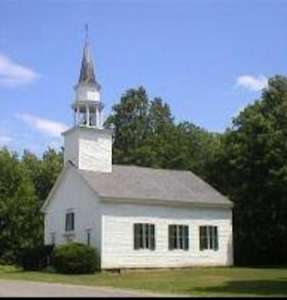
Clinton Academy, in 1942, was one of four elementary schools in town; they consolidated in 1957, and the next year the town sold the District #5 building to the Benton Falls Congregational Church, pictured here, for one dollar.

by Mary Grow

This subseries on education is organized by the dates the central Kennebec Valley towns were incorporated, and Clinton, in 1795, was next after Fairfield, in 1788. Therefore the history of education in Clinton, on the east side of the Kennebec River, opposite the northern part of Fairfield, follows the December 2024 articles on Fairfield.

However, until 1842, the southern part of Clinton – approximately half the town, and the first-settled part – was what became by a March 16, 1842, legislative act the separate town of Sebasticook, renamed Benton as of June 19, 1850. The early history of Clinton schools is therefore the early history of Benton schools as well.

* * * * * *

Clinton’s European settlement was shaped by the Kennebec River on its western boundary, and by the Sebasticook River, which maps show making a wiggly W shape in southeastern Clinton before flowing southish through present Benton into the east side of the Kennebec at Winslow.

Europeans made their way up both rivers. In his 1970 Clinton history, Major General Carleton Edward Fisher wrote that waterfalls and rapids made navigation challenging on parts of both. One of the easier stretches on the Sebasticook was between Winslow and the southern part of Clinton, up to the village now named Benton Falls.

Additionally, because the Sebasticook was the smaller river, it was easier to dam to provide water power, Fisher said. Consequently, the majority of early Clinton settlers stopped in the area that became Benton.

Fisher found it impossible to date the first settlement precisely, but he believed several families had arrived by the early 1770s. In Clinton, as in other central Kennebec valley towns, providing schools was not settlers’ top priority; Fisher mentioned 1790 and 1794 town meeting appropriations, with no record that any money was for schools.

Only after Clinton was incorporated in 1795, Fisher said, did voters specifically fund education. At a town meeting that year, they raised 20 pounds, then added 30 pounds more.

In March 1797, he wrote, town meeting voters provided $300 for teaching and $350 to build schoolhouses – and in April reconsidered and defeated the building money. In 1798, they allowed $150 for education, in 1799 and 1800, $200 each year. In 1800, they approved a separate $500 for school buildings.

Meanwhile, another 1797 vote empowered the selectmen to create school districts. In each district, voters elected a man to be “head of class.” Fisher’s description of the 1800 districts shows three on the Kennebec, numbered First, Second and Third, with three men in charge of six classes (one had one, one two and one three); and four more districts on the Sebasticook, two on the east side and two on the west, with more than nine classes (incomplete records left the total undetermined).

Students, defined as children aged four to 21, numbered 102 in the three Kennebec districts in 1800. Fisher found figures for only two of the four Sebasticook districts; they totaled 65. By 1803, he wrote, Clinton had more than 260 students.

As in other towns, district boundaries changed frequently, and so did methods of running the districts. Sometimes district residents chose their leaders, sometimes town meeting voters made the choices.

The first school committee was elected in 1821, Fisher wrote; this method continued until 1854, when voters instead elected a single school supervisor. They went back and forth between the two types of leadership until 1895.

Clinton had 13 school districts in 1820, Fisher said, increased to 15 in 1821 when the town school committee was created. That year, records showed 633 students; four districts had 60 or more, and the smallest had 13. By 1841, there were 21 districts.

At no point did Fisher identify the southern districts that were to become Sebasticook’s in 1842. His descriptions of historic boundaries, though meaningful to residents at the time, provide few clues in the 21st century.

After the 1842 division, 12 of the 21 districts remained Clinton’s and nine went to the new town. Clinton still had 12 in 1856, Fisher wrote. Number 12 was in Clinton Village; because of population growth there, it was divided and District 13 created in 1860, but in 1867 the two were reunited.

Fisher wrote that the buildings funded in 1800 didn’t get built, so in 1803 voters instructed each district to build its own. Because district records were not necessarily included in the town records, he found it hard to figure out what buildings were built when, though he cited examples from 1821 to 1839.

Schoolhouses were built near populous areas, obviously – Clinton Village on the Sebasticook, Pishon’s Ferry and Noble’s Ferry on the Kennebec, Morrison Corner and Town House Hill in mid-town.

The Morrison Corner schoolhouse was the earliest Fisher listed; voters in 1821 raised $166.51 for it. It appears on the 1856 and 1879 maps of Clinton as the second building north on the east side of the four-way intersection.

In 1895, Fisher said, voters approved a replacement building, apparently on a nearby lot, that was completed in August 1896. It served until 1963; in 1970, the building was a house.

A photo Fisher took in 1975 and included in his history shows a main building on a (not necessarily original) windowed basement, with a small single-story addition on one end. There are two second-floor windows above the addition, under the roof-peak, and no windows on the side of the main building.

Fisher dated the nearby Town House Hill school to 1826. He said it operated until 1932, and the 1826 building was a residence in 1970. His 1975 photo of this former schoolhouse shows a rectangular, single-story peaked-roofed building.

Like other historians, Fisher noted that from the 1700s into the early 1900s, most teachers doubled as janitors, responsible for cleaning, simple maintenance and building the fires in fireplaces or stoves all winter. They were not highly paid – he mentioned one woman earning $7 a week in the early 20th century.

Fisher identified discipline as a problem, giving several examples of teen-aged students, mostly but not all boys, testing teachers by giving them a hard time. He cited a teacher’s diary from 1861 describing misbehavior that ended with a hole in the floor. After some of the students responsible were made to pay to fix the floor, they apparently settled down.

* * * * * *

Fisher wrote that in the fall of 1831, a group of residents planned to open a high school for girls, to be named Clinton Female Academy – an unusual proposition for the time. Resident Asher Hinds deeded an eight-by-nine rod (132-by-148.5 foot) lot in what is now Benton Falls. (Fisher did not say whether it was a gift, or the school trustees paid for it.)

Hinds was a major landowner whose 300 acres included almost 100 acres in Benton Falls. He and his wife, Rebecca (Crosby) Hinds, had nine children, born between 1789 and 1809, of whom three daughters (and four sons) lived to maturity.

The girls’ school trustees ran out of money, Fisher said, and Clinton Academy became a coed school run by the Methodist Society. An on-line Benton history says the Academy building was put up in 1831, beside the Benton Falls meeting house.

The earliest school catalogue Fisher found was for 1845: of 83 students, six were from Clinton, as were two members of the board of trustees. (The rest were presumably residents of Sebasticook, soon to become Benton.)

In 1845, he wrote, the school met for two 11-week terms, the fall one starting in September and the spring one in March. Tuition for a term depended on what the student studied: $4 for languages, $3.50 for natural sciences, $3 for the basic course (defined in a 1918 textbook, found on line, as including reading, writing, history, geography, civics, arithmetic, physiology and hygiene).

The on-line history says the town library, organized in 1849, was headquartered in the Academy building.

The Academy closed in 1858, and the on-line history says the building later became the District 5 schoolhouse. It burned in 1870, and “the library was lost.”

In 1871, the history continues, the schoolhouse was rebuilt, though its “upstairs hall” wasn’t finished until 1883. In 1942, it was one of four elementary schools in town; they were consolidated in 1957, and the next year the town sold the District 5 building to the Benton Falls Congregational Church, for a dollar.

(Meanwhile, the library had reopened in 1900, in a storehouse that had been Asher Hinds’ when he ran a store at Benton Falls. That building burned in 1914. An on-line search for Benton library yields a reference to the Brown Memorial Library, in Clinton [see Clinton’s website and the Dec. 2, 2021, issue of The Town Line for more information on this library].)

Clinton officials obeyed state law and opened a free high school in 1873, with voters appropriating $300 for it, Fisher wrote. Henry Kingsbury, in his 1892 Kennebec County history, said it started in 1874 with a $500 appropriation.

As in other towns, high school classes initially met in district schools for a single term (seven to 10 weeks in Clinton). Fisher, like the Fairfield Register writer cited on Fairfield high school two weeks ago, commented that courses offered were at first barely above eighth-grade level.

By 1892, Kingsbury said, there were spring and fall terms each year, taught in district schools and well attended.

In 1898, according to Fisher, high school classes moved to the village school. The first graduating class, of five students, was in 1902. The first high school building in Clinton opened in 1903 (all 12 grades held classes there until about 1940).

A 1969 photo credited to Paul W. Bailey shows a three-story wooden building with basement windows, by then Clinton’s Baker Street School for elementary students. Historical information on the town website says the building was 68-by-40 feet and had three classrooms on each of the first two floors and one on the top floor. The privy was in a separate building behind the school.

After creation of Maine School Administrative District (MSAD) #49 in 1966, high school students went to Fairfield. The Clinton building burned – probably by arson — on July 25, 1975.

* * * * * *

Kingsbury wrote that when Benton became a separate town in March 1842, it included nine of Clinton’s school districts, and by 1892 a tenth had been added. As of 1892, he wrote, each district had “a comfortable and well-appointed school house, uniform text books are used, and the entire school property is valued at about $3,500.”

Up to 1892, Benton had a high school in the Benton Falls schoolhouse, in District 5, Kingsbury said. He did not say when it opened; presumably in 1873. In 1892 voters appropriated no money to continue it, “the proximity of Waterville offering advantages in higher education with which it was useless for Benton to compete.”

Main sources

Fisher, Major General Carleton Edward, History of Clinton, Maine (1970)
Kingsbury, Henry D., ed., Illustrated History of Kennebec County Maine 1625-1892 (1892)

Websites, miscellaneous.

CAMPAIGN 2024: Candidates address issues concerning Maine voters (Part 4)