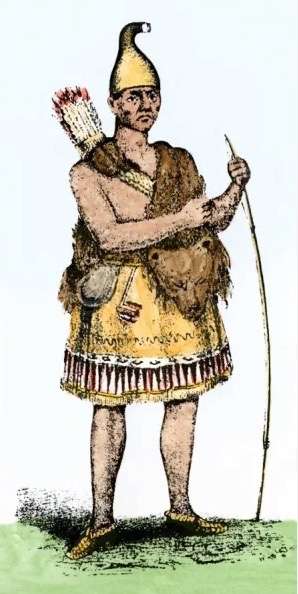
The French gave the name Abenaquiois (Abenaki) to all the Indians east of the Connecticut Rver, but the name becaume gradually restricted to the dwellers of the Kennebec Valley. These Indians also carried the name Canibas. Before the great Indian war of 1615, it appears the Bashaba or great chief who lived on the Penobscot exercised a kind of general sovereignty over all the Maine tribes.
The tribe extended from Merrymeeting Bay to Moosehead Lake and enjoyed the forests, the fertile meadows, the rivers teeming with fish and affording a broad highway for their canoes, an ideal place for Indian habitation. In the winters the Indians retired to the woods and lakes further north where they found it easy to secure the moose and deer in the deep snow. With the coming of spring they descended to the rivers in time to get the salmon, shad and alewives. In the summer they had their scanty harvests of berries and wild fruits in the forest.
Several important Indian villages were on the river. At Fort Hill, in Winslow, was a large village extending along the banks of the Sebasticook and the Kennebec rivers, extending nearly a mile. Large quanities of pottery were found, wholly Indian made. Flint clippings were found in abundance as well as fine specimens of arrow points, gouge, etc. It’s noteworthy that no metal has been found there except beads of pure copper, thus showing the settlement antedated European trade and also the village at Norridgewock where iron of Eurepean manufacture, pipe stems, etc., were found.
The village at Fort Hill was probably the ancient Teconnet although the name belonging first to the Falls, was applied to territory on both sides of the river. The only grave yard in the western part of Winslow is small in extent and was located near the former wheel house of the paper mill.
In Waterville, there were no indications of Indian villages. No pottery found, but more recently, along the river and streams, sinkers and arrow heads are common. However, there was a large burial ground here extending from what is now Temple Street to the site of the Lockwood mills. When the Dunn Block was erected, the body of an Indian buried in a sitting posture was found. Many implements were buried with him and about two quarts of copper beads. About the same time, six skeletons in a single forenoon’s digging in the open space at the junction of Main and Water streets were discovered. Here, evidently was the burial place of old Teconnet.
Print of Bashaba.
In 1643 an Indian who had become a Christian under the labors of the Catholic French missionaries at Sillery and Québec, came down the Kennebec as far as Augusta and told the Indians of the beauty and majesty of the new faith. He took back with him an Indian chief whose life had been saved by the intercession of the missionaries. He was baptized in Sillery under the name of John Baptist. Later a considerable intercourse grew up between the Indians of the Kennebe and those about Sillery and in 1646 a delegation appeared before a council of the fathers at that place and begged that a missionary might be sent to the Indians of the Kennebec. They said that 30 men and six women had embraced the new faith and they desired a missionary to baptize and teach. Father Gabriel Druillette was appointed and August 29, 1646, started for his mission field. He found a hearty welcome.
After a stay at Nahrantsouak and Teconnet he arrived at Cushnoc (Augusta) late in September where he was entertained by John Winslow, the Pilgrim trader. Father Druillette received the encouragement of the Plymouth Compnay and established a successful mission at Gilley’s Point, about three miles north of Augusta.
Father Druillette, after his return from the Kennebec was constantly employed. In 1666 he went with Marquette and labored at Sault St. Mary for 13 years. He died in Québec in 1681.
Meanwhile the English had been getting more assured possession of the land. The titles to land coming into question, the English secured deeds of the Sagamores, though it is a matter of question whether the Indians understood they were conveying exclusive rights. In 1648, a Sagamore conveyed to Gov. Bradford all land on both sides of the River to Wesserunsett. In this deed Waterville is included.
In 1653, the General Court of Massachusetts directed Thomas Prince to summon the citizens on the River Kennebeck that they migh take an oath of allegiance and arrange a judicial code. This was done at the residence of Thomas Ashley near Merrymeeting Bay, where on May 23, 1654, 16 men assembled, took the oath and in their code of laws promulgated the first prohibitory law of Maine. It provided penalties for selling liquor to the Indians as they, when intoxocated, were often guilty of “much horrid and wickedness.”
King Philip’s War, the first war with Indians, extended to Maine in the autumn of 1675. For years there had been increasing friction between the Indians and the English. The French had won the friendship of the Indians, sent them priests, sold them powder and guns and had been their allies in conflicts with other tribes. The English had treated them as inferiors, had sought profit in sharp business practices, had been suspicious and prompt to punish offenses and often refused to sell powder or guns.
With the first outbreak the Canibas tribe returned to Teconnet, to await developmens. The trade upon the river at this time was largely in the hands of Clark and Lake and Richard Hammond. Hammond had a trading house at Woolwich, Clark and Lake had estblishments at Arrowsic and both had trading houses at Teconnet Falls. A committee sent by Massachusetts to have general control over military and other measures of safety met seven of the Canibas tribes and five of the Androscoggins, Mahotiwormet or Robinhood being leader.
The Indians surrendered their guns and mutual professions of friendship were made.
To be continued
Source:
Centennial History of Waterville, 1802-1902, by Rev. Edwin Carey Whittemore
Responsible journalism is hard work! It is also expensive!
If you enjoy reading The Town Line and the good news we bring you each week, would you consider a donation to help us continue the work we’re doing?
The Town Line is a 501(c)(3) nonprofit private foundation, and all donations are tax deductible under the Internal Revenue Service code.
To help, please visit our online donation page or mail a check payable to The Town Line, PO Box 89, South China, ME 04358. Your contribution is appreciated!
Roland is the managing editor of The Town Line newspaper. He has 56 years experience in the newspaper business, having worked in production departments at the Waterville Morning Sentinel, has been general...
More by Roland D. Hallee