

 by Roland D. Hallee
Last week I was asked various questions about the Asian ladybug, in particular. I have done columns on lady bugs in the past, but none on the Asian variety.
This is one of the most variable lady beetle species in the world, with an exceptionally wide range of colour forms. It is native to eastern Asia, and has been artificially introduced to North America and Europe to control aphids and scale insects. It is now common, well known, and spreading in those regions, and has also established in Africa and widely across South America. This species is conspicuous in North America, where it may locally be known as the Halloween beetle, as it often invades homes during October to overwinter. Other names include multivariate, southern.
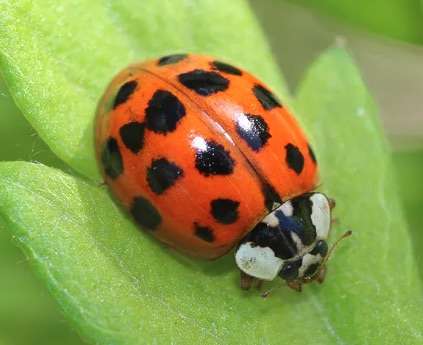
The common color is orange or red in coloration with 0 – 22 black spots of variable size. As a voracious predator, it was identified as a biocontrol agent for aphids and scale insects. Consequently, it has been introduced into greenhouses, crop fields, and gardens in many countries, including the United States and parts of Europe. The species is now established in North America (United States, Canada, Mexico), Central America South America, Europe, New Zealand, and South Africa.
This species spread across continents because of human-mediated processes. They became established in North America as the result of introductions into the United States in an attempt to control the spread of aphids. In the last three decades, this insect has spread throughout the US and Canada, and has been a prominent factor in controlling aphid populations. The first introductions into the US took place as far back as 1916. The species repeatedly failed to establish in the wild after successfully controlling aphid populations, but an established population of beetles was observed in the wild near New Orleans, Louisiana, in about 1988. In the following years, it quickly spread to other states.
Large aggregations are often seen in autumn. The beetles have pheromones to signal to each other. However, many aggregation cues are visual, picking out sites at both long (light-coloured structures that are distinct from their surroundings) and short (pre-existing aggregations to join) distances. Non-volatile long-chain hydrocarbons laid down by previous aggregations also play a significant role in site selection. Both visual and hydrocarbon cues are more important than volatile pheromones.
They often congregate in sunlit areas because of the heat available, so even on fairly cold winter days, some of the hibernating beetles will “wake up” because of solar heating. Large populations can be problematic because they can form swarms and linger in an area for a long time. The beetles can form groups that stay in upper corners of windows. This beetle has been also found to be attracted to dark screening material for its warmth. It has good eyesight; it will return to a location from which it is removed, and is known to give a small bite if provoked.
They use isopropyl methoxy pyrazine as a defensive chemical to deter predation, and also carries this chemical in its hemolymph at much higher concentrations than many other ladybeetle species, along with species- and genus-specific defensive compounds such as harmonine. These insects will “reflex bleed” when agitated, releasing hemolymph from their legs. The liquid has a foul odor (similar to that of dead leaves), a bitter taste, and can stain porous materials. Some people have allergic reactions. Occasionally, the beetles will bite humans, presumably in an attempt to acquire salt, although many people feel a pricking sensation as a beetle walks across the skin. Bites normally do no more harm than cause irritation, although a small number of people are allergic to bites. Their natural predators include birds, spined soldier bugs, and ants.
The best methods for dealing with them in private homes involve sealing openings they may enter. Sweeping and vacuuming are considered effective methods for removing them from homes, though this should be done carefully so as not to trigger reflex bleeding. A nylon stocking placed inside the vacuum cleaner’s hose, secured with a rubber band, allows the beetles to be “bagged” rather than collected inside the machine. A trap designed for indoor use was developed which attracts the beetles with a light and seals them in a removable bag.
Many times, they are the favorite bug of children. Best to leave the ladybugs alone unless you are removing them.
Roland’s trivia question of the week:
What former Boston Celtics player won 11 NBA titles in his career.
Responsible journalism is hard work!
It is also expensive!
If you enjoy reading The Town Line and the good news we bring you each week, would you consider a donation to help us continue the work we’re doing?
The Town Line is a 501(c)(3) nonprofit private foundation, and all donations are tax deductible under the Internal Revenue Service code.
To help, please visit our online donation page or mail a check payable to The Town Line, PO Box 89, South China, ME 04358. Your contribution is appreciated!