HealthReach welcomes new Clinician, Luigi Santilli, FNP

Luigi Santilli

This February, staff at the Madison Area Health Center are happy to welcome Luigi Santilli, FNP, to their professional healthcare team.

Santilli earned his Family Nurse Practitioner degree from Husson University. Previously, he also earned a Bachelor of Science degree in Nursing from the University of Maine at Fort Kent and a Bachelor of Arts in Biology from the University of Maine Augusta. Santilli’s nearly eight years of medical experience includes emergency and ICU care, infusion, and travel nursing. Santilli also completed clinical experience for his FNP degree at HealthReach’s Sheepscot Valley Health Center. His extensive range of experience, paired with familiarity of the HealthReach community, will make him a great addition to the Madison team.

Of his new position with HealthReach, Santilli said, “I am looking forward to bringing a patient-first mindset to the healthcare community. I wish to be diverse in my practice and care for the community that I love in a direct and impactful way.”

Santilli joins the existing Madison clinical team – Family Nurse Practitioner, JoHanna Davis; Psychiatric Mental Health Nurse Practitioner, Kelly Bell Bragg; Licensed Clinical Social Worker, Madison Chadbourne; and Licensed Clinical Professional Counselor, Lauren Emery.

Area residents named to dean’s list at UNE (Fall 2025)

The following students have been named to the University of New England’s dean’s list for the fall semester 2025, in Biddeford, Portland and Morocco, in the marine sciences, the natural and social sciences, business, the humanities, and the arts. Visit www.une.edu.

Augusta – Natalie Dube, Mallory Erickson, Trenton Hayward and Tyler Pelletier; China Village ­– Nabila Harrington; Fairfield – Jayden Lovely and Caitlyn Mayo; Jefferson – Ava White; Liberty – Mckenzie Kunesh; Madison – Aurora Norsworthy; Norridgewock – Madison Robinson; Oakland – Francesca Caccamo; Skowhegan – Catherine Kelso, Zoe Lambke, Ashley Mason and Drake Turcotte; Vassalboro – Adam Ochs; Waterville – Asher Grazulis, Emma Michaud, Elias Nawfel, Grace Petley, Tyson Smith and Evan Watts; Winslow – Emilee Richards.

Call for quilts to display at Vassaslboro UMC quilt show

Display spaces are available for quilt entries at a Quilt Show, in Vassalboro, on Saturday, February 14 (snow date February 21). This photo is from the 2025 Quilt Show. (photo by Dale Potter-Clark)

There are quilt display spaces available at the “Cabin Fever Quilt Show” to be held at the Vassalboro United Methodist Church (VUMC), 614 Main St., on Saturday, February 14 (storm date Feb. 21st). There is no entry fee. Quilts of all sizes, ages, patterns and skill levels will be draped over the pews and hung along the walls in the sanctuary, producing an impressive array of creations. A lasagna luncheon will add to the day’s enjoyment. To enter quilts, whether vintage or newer, contact Judy Goodrich at jgoodrich1954@gmail.com or call or text (207) 530-1564.

The Vassalboro Historical Society (VHS) will display several antique quits from their collection in “bed turnings” at 9:30 a.m. and at 1 p.m., when the VHS Curator will share information about each quilt as it is turned. There will be tags applied to the other quilts on display and hosts will be on standby to answer questions that may arise. There will be drawings for door prizes for which Quilt Show attendees will be eligible. Some newly made quilts will be available for purchase, a percentage of which will be designated to the VUMC building fund as will all proceeds from the day.

Admission to the Quilt Show is by donation; quilts will be on display 10 a.m. – 2 p.m. The luncheon is $10 per person and will be served 11:30 a.m. -1 p.m., to include meat and vegetable lasagnas, special desserts and sweets with Valentine’s Day in mind. Luncheon tickets will become available at 11 a.m.

Follow this and future special events and public meals on the Vassalboro United Methodist Church Facebook page.

Stratton wins Whitefield Library chili contest

Olivia Stratton

The Whitefield Library’s 3rd Annual Chili Contest, held on Saturday, January 24, has a new reigning champion in Olivia Stratton.

Judges from Pittston, Whitefield, Nobleboro, and Jefferson tasted and rated 13 chilis to determine the winner. They scored the chilis based on presentation, taste, heat, aroma and texture. Competitors entered a variety of chilis including venison, beef and pork, chicken, turkey, and vegetarian.

Olivia Stratton, of Somerville, entered her famous ground beef chili that had just the right amount of heat. Diners raved about how well it tasted.

There was a People’s Choice award given out which was won by last year’s Chili champion Amy Perkins.

Besides chili, people could have cornbread, mac and cheese, and dessert. This year’s event had a new children’s corner with all kinds of fun activities including a cupcake walk, face painting, and building a tower of cups.

The library is located at 1 Arlington Lane, Whitefield. The Chili Contest is one of many fundraisers held to help support future library programming. For more information, email us at: info@whitefieldlibrary.org.

China planning committee continues ordinance updates

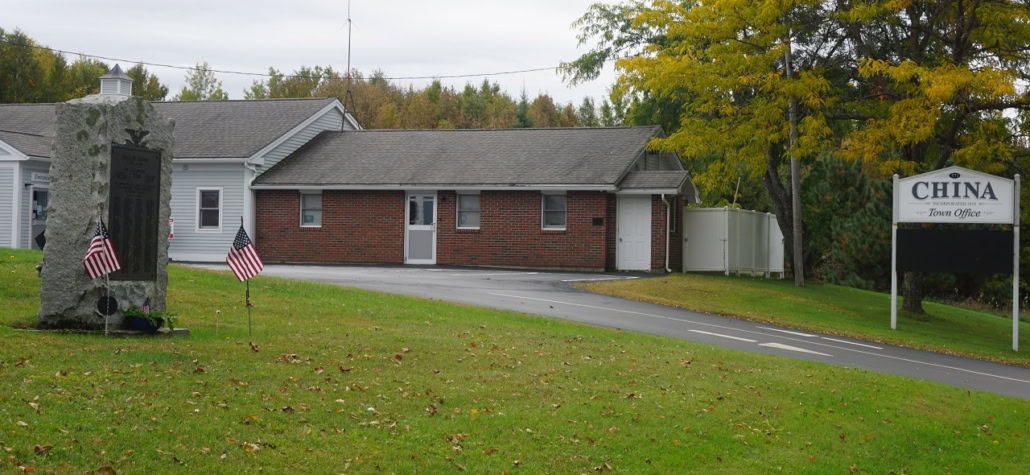
China Town Officeby Mary Grow

China Planning Board members continued work on updating town ordinances at their Jan. 27 meeting, having received advice and suggestions from Jeff Dennis of the state Department of Environmental Protection (DEP) water quality bureau.

Board chairman Toni Wall had from Dennis current standards by which to evaluate proposed phosphorus control measures in applications to build in China Lake and Three Mile Pond watersheds. Board members approved of the more specific information on run-off prevention buffers.

The goal, as board member Milton Dudley put it, as to have ordinance requirements that the board can administer and that are “not so complex as to deter applicants.”

Wall and Bruce Fitzgerald think including the standards in the ordinance would be better than referring applicants to a DEP document.

Wall intends to prepare a new draft phosphorus control ordinance and ask Dennis to review it.

The other ordinance on the Jan. 27 agenda was the Flood Plain Ordinance, which Wall said was last updated in 2011. She and Fitzgerald each had prepared suggested changes, mostly non-substantive, like changing “board of selectmen” to “select board.”

Looking for ideas in other Maine towns’ ordinances, Wall found some assigned administering flood plain ordinances to the codes officer, instead of the planning board.

China codes officer Nicholas French said he could take on the job. Board members leaned toward making the change, but with one member absent, postponed a decision.

The next regular China Planning Board meeting is scheduled for 6:30 p.m., Tuesday, Feb. 10, in the town office meeting room.

China community food pantry prepares for their next chapter

Larry Lemieux, left, and Carl McKeil, standing next to the pantry’s cargo van used for food pickups and deliveries. (contributed photo)

by Jeanne Marquis

As with many great ideas, the China Community Food Pantry began with a simple conversation. In October 1992, when Lee and Ann Austin were renovating the first level of their lodge, a couple came to the door by the name of Jeremiah and Lynn.

“We’d never seen them before,” Ann recalls. “They told us God said we were supposed to start a food pantry in China. We said, ‘Oh.'”

That was quite an audacious statement for near-strangers to blurt out. But Lee and Ann, both being rational, civic-minded people, mulled it over for a while and thought the idea had some merit. Was this a God moment or an act of fate, who knows? What the Austins knew for certain was the area needed a food pantry – at the time, the only food pantries in Maine were housed in local churches.

This conversation sparked the beginning of the China Community Food Pantry, 32 years ago, in the green and brown shingled building that had once been the lodge of the Willow Beach Camps Resort.

The Austins’ instinct proved well-timed – Maine was in the grip of a significant economic downturn. In the early 1990s, based on available records from the University of Maine 1, the state was experiencing a significant economic downturn that directly impacted food security. The statewide poverty rate increased from 10.8 percent in 1989 to 14.1 percent by 1991. Real median family income in the state declined from $30,998 to $27,868. Childhood food insecurity affected 15.7 percent of all children under five in Maine in 1992. The need for emergency food was significant enough that then-Governor John R. McKernan Jr. designated the week of October 28, 1992, as Maine Ending Hunger Week.

The Austins built the pantry on a simple philosophy: neighbors helping neighbors. “When somebody’s in need, their neighbors help them out,” Ann explains. “And when they get back on their feet, they help somebody else.”

In those early years, both a dedicated core group of volunteers and clients grew quickly for the fledgling food pantry. Recipients of the food came from beyond the Town of China, including residents of nearby communities. The Austins reached out for reliable sources of donated food. Hannaford’s changed their corporate policy to allow them to donate food instead of allowing tons of it to go to waste. The Good Shepherd Food Bank, based in Lewiston, brought up food to fill the needs of the China pantry’s growing client base. Lee Austin helped share the knowledge he and Ann learned about setting up a community food pantry to the towns of Palermo, Albion, Windsor and Vassalboro. The community food pantry movement grew across the state, filling a well-documented need.

How China Community Food Pantry adapted to change

Over the years, the China Community Food Pantry has adapted to emergencies and changing needs. In March 2020, the pantry quickly established protocols to react to the COVID-19 medical emergency to protect their volunteers and customers. They provided pre-made food boxes that the volunteers delivered directly to the customers’ cars. This system not only cut down the spread of COVID, it turned out to be very efficient so it is still in place today.

Pets joined the list of recipients when a generous China resident began donating pet food regularly. Now others have also stepped up to donate dog and cat food. Periodically, a request for pet food is posted on the Friends of China Facebook page.

In 2019, the food pantry purchased a used cargo van, funded entirely through donations. This vehicle is driven by volunteers to local grocery stores and farms to provide greater access to food.

Most recently, the pantry has adapted to serve an increase in clients due to the uncertainty of the SNAP program, cuts to federal funding and rising food costs. With the uncertainty of the economy, the pantry will be ready to face what is up ahead, especially with the support of community members, farmers and businesses.

What’s the next chapter for the China Community Food Pantry?

It has been ten years since Ann took over as the head of China Community Food Pantry after her husband, Lee, lost his battle with pancreatic cancer in 2016. The work is never-ending even with a robust group of loyal volunteers.

Just as the China Community Food Pantry began from a conversation, the pantry’s next chapter did as well. Ann’s family came to her and thought there should be a plan in place to position the pantry for the future and provide Ann with some well-deserved help. Ann was thinking along the same lines. She said she had a great group of loyal volunteers, some who were retirees from business careers, who she trusted as board members.

In the summer of 2025, the China Community Food Pantry was legally reorganized as a public charity 501(c)(3) with officers and a board of directors.

Officers: President Tom Parent, Vice President Cindi Orlando, Treasurer Jane Robertson, Secretary Donna Loveland, and Operations Officer Ann Austin.

Board of Directors: Jean Dempster, Nancy Lemieux, Larry Lemieux, and William Robertson.

The China Community Food Pantry is open noon – 1 p.m., Friday and Saturday, at 1320 Lakeview Drive. Donations may be mailed to P.O. Box 6012, China Village, ME 04926.

The next step to provide a stable future for the pantry is for the board to find a new location. For over 30 years, the Austins have graciously provided housing for the pantry and its operation within their home at no cost, except for electricity.

President Tom Parent explained, “Options are limited in China, but we do have a few locations that we are exploring.  While renting is an option, doing so would substantially increase our annual budget by about three-fold, from about $15,000 to about $45,000 per year, or more.  Long-term lease agreements for 3-5 years would be difficult without a guaranteed revenue stream to cover rent. The pantry acquires about $15,000 per year from donations. There has not been any government funding of any form.”

The need for a food pantry in the China area is greater than ever

The food pantry serves an average of 75 families per week with a total of 125 families affected throughout the course of a year. These families are comprised of about 260 people of all ages, with the majority being elderly and children. They have about 30 regular, reliable and committed volunteers doing the work, and there is no compensation to anyone for this entire operation.

Food insecurity is still nearly as high as it was 30 years ago with the recent cuts to federal programs and the uncertainty in our economy. Maine’s percentage of the population who face food insecurity is at the nation’s average of 12.2 percent according to the USDA Economic Research Service Data of 2023 [2]. Almost one in three Maine seniors face hunger or threats of hunger when their fixed income doesn’t stretch far enough or when their budget is thrown off by a large medical or heating bill.

After more than three decades, Ann Austin is ready to step back – but not away. “I tell people, ‘I’m working myself out of a job here,'” she says with a laugh. What gives her confidence is knowing the pantry’s founding philosophy will endure. “Our volunteers share the same vision Lee and I started with: neighbors helping neighbors.”

Until a new location is found, the China Community Food Pantry is open noon – 1 p.m., Friday and Saturday, at 1320 Lakeview Drive. Donations may be mailed to P.O. Box 6012, China Village, ME 04926.

Sources:

[1]  Identifying childhood hunger in Maine Maine Policy Review (1993). Volume 2, Number 2 by Deirdre Mageean Margaret Chase Smith Center for Public Policy University of Maine
[2]  Food Security in the U.S. – Key Statistics & Graphics | Economic Research Service.

Louisa Barnhart speaks about Asian trip

Panda laying in a large enclosure.

by Mary Grow

Guest speaker Louisa Barnhart had a ready answer Sunday afternoon, Jan. 18, when an audience member at the Albert Church Brown Memorial Library asked her the favorite part of her Asian trip last November.

“The camels in Mongolia,” she replied.

The camels were two-humped Bactrian camels, and Barnhart got to ride one, seated between the humps. “Very comfortable,” she said.

Mongolia also has another kind of camel that has only one hump, and dromedaries, Barnhart said.

In a different part of the country, Barnhart saw pandas, the familiar black and white ones and the less familiar red pandas. Both, she said, were on the verge of extinction, until a government breeding program reversed the decline.

One of the photos with which Barnhart illustrated her talk showed a black and white panda in a large enclosure, lying on his or her back chewing on a piece of bamboo.

She also displayed a stuffed panda whose outer coat can be reversed to make the toy either a red panda or a black and white panda. Another souvenir was a hank of camel wool, intriguing to knitters in the audience.

Two other Mongolian features Barnhart saw are some of the many dinosaur fossils found there from the 1920s on – Mongo­lia’s Gobi desert has more dinosaur fossils then anywhere else in the world, she said – and the round wooden buildings called gurs (known elsewhere as yurts) where rural families live.

A village of gurs, or yurts, as we know them.

She watched while a five-man team assembled the components of a medium-sized gur into a home in 17 minutes. The buildings are windproof and “incredibly warm at night,” she said – necessary in a climate where, in late November, there was snow on the ground and the temperature was at or below zero, Fahrenheit.

Ulan Bator, Mongolia’s capital, is a very modern city, as are other major cities Barnhart visited in China and Japan. Her photo from Ulan Bator showed extensive Christmas decorations.

“All of Asia is crazy about Christmas,” she commented. She was unable to find out why.

Japanese and Chinese cities are colorful compared to United States cities. Buildings are elaborately decorated and painted in reds, oranges, yellows and other bright colors, varying from country to country.

In Lhasa, Tibet’s capital, Barnhart visited Potala Palace, the former winter home of the Dalai Llama, accessed by 400 steps (which she climbed).

Potala Palace, in Lhasa, Tibet.

In Xian, China, she viewed the terracotta warriors dating from the 250s B.C. Rows of terracotta figures, probably once painted, now clay-colored, stand in the excavated area. A much larger area has not yet been excavated, because, Barnhart said, there is a legend that it is full of rivers of mercury and booby-trapped.

Most of the figures had been broken and reconstructed. Barnhart had a photo of one reportedly found intact, a soldier kneeling on one knee.

The terracotta warriors dating from the 250s B.C.

The excavated area lies under an immense roof, with space for viewers around the sides. Asked for her least favorite part of the trip, Barnhart said standing in that crowd, so closely packed that she hesitated to try to get to the front for a better view.

Another topic that intrigued Barnhart, and delighted her audience, was toilets, specifically “luxurious Japanese toilets, with heated seats.” In both China and Japan, she said, public toilets are free and immaculately clean.

Barnhart added Asian refreshments to her presentation. Chef James Cooper, of China Lake Provisions, provided generous bowls of Japanese salad, which Barnhart described as “Wafu salad with garlic soy tenderloin.”

Other offerings were Mochi, a Japanese rice-cake treat; Japanese crackers; and three different Chinese teas. Audience members were invited to take food home.

Louisa riding her camel.

William Dudley achieves rank of Eagle Scout

Kellie Dudley pins the Eagle Scout medal on her son while Troop #401 Scoutmaster Eric Handley looks on. (photo by Chuck Mahaleris)

by Chuck Mahaleris

William R. Dudley, of Sidney, son of Joel and Kellie Dudley, was presented the Eagle Scout award during a special ceremony held in his honor at the James H. Bean Elementary School, in Oakland. The location is fitting as Dudley’s Eagle Scout project had several benefits for the school including building an outdoor classroom and a bridge.

Since it was first awarded in 1912, more than two million young people have achieved Scouting America’s highest rank. The study conducted by Baylor University, Merit Beyond the Badges, found that Eagle Scouts are more likely than men who have never been in Scouting to:

  • Have higher levels of planning and preparation skills, be goal-oriented, and network with others;
  • Be in a leadership position at their place of employment or local community;
  • Report having closer relationships with family and friends;
  • Volunteer for religious and nonreligious organizations;
  • Donate money to charitable groups;
  • Work with others to improve their neighborhoods.

Gerald Ford, who earned the Scouter of the Year Award in 1974 – while he was president. JFK was the first Boy Scout – but not Eagle Scout – to hold the nation’s top office; Bill Clinton and George W. Bush were both Scouts, too, but never advanced beyond Cub.

Astronaut Neil Armstrong is perhaps the most famous Eagle Scout and now William Dudley joins him in soaring high. State and federal representatives applauded his accomplishment as did various organizations such as the U.S. Marine Corps League.

Town of Oakland launches facade improvement grant program

The Town of Oakland is launching the Oakland Façade and Downtown Improvement Grant Program (OFDIG) to support a more vibrant, welcoming, and economically resilient downtown. The program will provide funding to local business and property owners for exterior building improvements that enhance Oakland’s commercial corridors and strengthen downtown appeal.

Through OFDIG, the Town has allocated $25,000 for exterior upgrades such as painting, signage, lighting, accessibility improvements, and façade repairs. The initiative builds on recent downtown planning efforts, including the Town’s new Downtown TIF District and Comprehensive Plan, and aims to support reinvestment, preserve local character, and boost small-business activity.

“Oakland’s downtown continues to grow and evolve as a welcoming and energetic hub for residents, businesses, and visitors alike,” said Kelly Pinney-Michaud, Oakland Town Manager. “This program provides an opportunity to invest directly in our community’s vibrancy and vitality. By improving the face of our downtown, we’re also strengthening the sense of pride and connection that makes Oakland such a special place.”

The program is designed to be flexible and accessible, allowing a range of project sizes and types. While not required, applicants are encouraged to include quotes or bids with their submissions, as proposals demonstrating readiness will receive preference in the scoring process. Applications will be reviewed in February, with awards announced in March and project completion expected by early fall 2026.

“Facade improvement programs are catalytic tools in downtown revitalization and investment attraction,” said Garvan Donegan, President and CEO of the Central Maine Growth Council. “When property owners and businesses reinvest in the visual and structural quality of their buildings and spaces, it signals confidence to both the market and the community. These visible upgrades not only enhance a sense of place but also help attract new entrepreneurs, business, talent, and capital—creating a ripple effect of reinvestment and long-term economic vitality.

Beyond funding, the program reflects Oakland’s commitment to strengthening quality of place, supporting local business growth, and advancing shared community and economic development goals.

For details, registration information, or application materials, please visit: https://www.oaklandmaine.us/downtown-tif-page.

Scouts to be honored in Vassalboro on Scouting Sunday

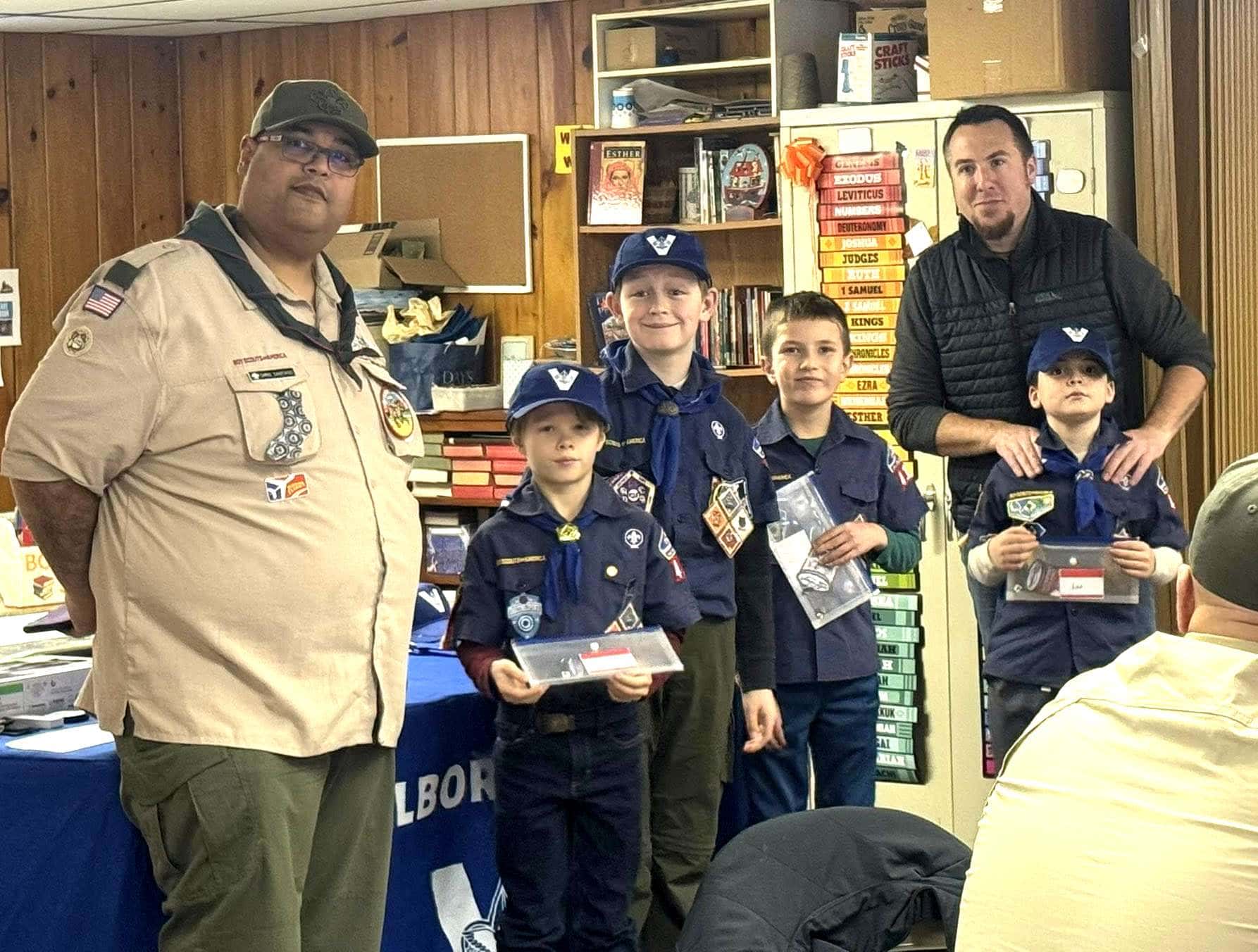
Advancement ceremony at VUMC in December of the Scouts #410 Webelos Den (fourth Graders): Cubmaster Chris Santiago and Den Leader Chris Reynolds with Declan McLaughlin, John Gray, Beckett Metcalf, and Lux Reynolds. (contributed photo)

by Dale Potter-Clark

Scouting Sunday is February 8, when Vassalboro BSA Scouting Troop #410 and Pack #410 will take part in the 10 a.m. worship service at their hosting organization, the Vassalboro United Methodist Church, at 614 Main Street. The public is invited to attend the special service and the lunch and time of fellowship that will immediately follow.

The celebration of Scouts Sunday is an opportunity for the community to acknowledge and support the Scouts’ dedication and hard work throughout the year; and to emphasize the importance of faith and duty to God as integral parts of the Scout Oath and Law. Scouts will attend in uniform and participate in some traditional aspects of the service, present the colors and share their experiences in scouting.

Boy Scouts were founded in England in 1908. The next year Chicago publisher, William D. Boyce was visiting London when he lost his way in a dense fog and a British Boy Scout came along and safely guided Boyce to his destination. When Boyce offered the youngster a tip he refused it, explaining that as a Scout he would not take payment for doing a good deed. This gesture inspired Boyce and he established Boy Scouts of America on February 8, 1910.

Vassalboro Scout Troop #410 received its charter in January 1970 from the Kennebec Valley District of the Pine Tree Council. At that time the troop was chartered by the East Vassalboro Grange and meetings were usually held there. Today the Vassalboro Scouts are chartered by the American Legion Post #126 and hosted by the Vassalboro United Methodist Church. According to Scoutmaster, Christopher Santiago there’s currently 44 Scouts – 28 in the Cub Pack and 14 in the Troop. When asked how the Vassalboro Scouts grew to such proportions Santiago related, “People found out by word of mouth about all that we do with our Scouts, which attracted some from outside of town.” Vassalboro BSA Scouting Troop and Pack #410 members are currently residents of six towns – China, Windsor, Palermo, Jefferson, Benton and Vassalboro.

If there is a storm this service will be postponed to Sunday, February 15, and notice of that would be posted on the Vassalboro United Methodist Church Facebook page. FMI call or text Pastor Karen Merrill at (207) 441-7086 or email info.VUMC@gmail.com. FMI about the Vassalboro Scouting Troop and Pack #410, email Scoutmaster Christopher Santiago at vassalborocubscoutpack410@gmail.com or follow them on Facebook.

Advancement ceremony at VUMC in December of the Scouts #410 Tiger Den (first graders): Cubmaster Chris Santiago and Den Leader Jamie Santiago with Maverick Quirion, Finn Theberge, Cameron Rairdon, Clay Rairdon, Ryan Kimball, and Eli Lathrop. (contributed photo)